
135
United Nations Praises Mexico’s Bold New Climate Strategy
Mexico’s Pacific coast hit by tropical storm and hurricane
UNESCO partners with a university strategy in Mexico to promote peace
Mexican authorities rescue over three thousand trafficked baby turtles
Everyday Customs & Etiquette in Mexico
The Ancient Games: Ball Courts

Mexico City – Mexico has officially launched its new National Climate Strategy, marking a major step in its commitment to climate action, sustainable growth, and inclusive development. Presented with support from the United Nations, the strategy outlines a bold path toward a greener future that strengthens both the economy and the well-being of communities nationwide.
UN Climate Change Executive Secretary Simon Stiell praised the strategy not simply as a policy document but as a clear roadmap for Mexico’s future – one grounded in the real needs of its people, cities, and rural areas. He highlighted it as a tool for turning climate ambition into action that delivers long-term benefits such as stronger livelihoods, cleaner air, and energy security.
 “This is a blueprint for real results,” Stiell said, noting that the strategy goes beyond cutting emissions. It is designed to create jobs, reduce health costs, improve public transportation, and bring clean power to remote areas – all while protecting the environment.
Mexico’s national plan includes forward-looking measures such as expanding solar energy in rural regions, investing in climate-smart agriculture, and ensuring clean air in urban centers. It also supports energy reforms aimed at achieving universal access to electricity and promoting sustainable innovation.
According to Stiell, the clean energy transition is already a $2 trillion global market, and Mexico is well-positioned to become a major player. With its natural resources, skilled workforce, and strong national vision, the country could become a global hub for renewable investment and technology.
However, Stiell emphasized that ambition must be matched by effective implementation. He called for coordinated efforts between national and local governments, Indigenous communities, civil society, and the private sector to ensure that climate solutions benefit everyone.
“This is a golden opportunity for Mexico,” he said. “The stronger the climate plan, the greater the rewards – in investment, innovation, and global influence.”
UN Climate Change pledged to support Mexico as it turns its strategy into real-world impact. As the country prepares to submit its updated Nationally Determined Contribution under the Paris Agreement, international leaders see this as a pivotal moment that could shape Mexico’s role in the global clean energy economy.
The new strategy signals that Mexico is ready to lead with bold, inclusive action – aimed not only at protecting the planet, but at building a more prosperous and resilient future for all its people.


The second Trump administration has come out swinging on trade. New tariffs — some targeted, others startlingly wide-ranging and broad — have reignited uncertainty across global supply chains and forced America’s economic allies to find ways of placating the White House.
For Canada and Mexico, Washington’s partners in Trump’s U.S.-Mexico-Canada Agreement, this has been a stark reminder of how easily trust can erode, even in the most integrated trade relationship in the world.
But the first formal review of the agreement in 2026 offers the opportunity to not only overcome this uncertainty but also to build for a stronger shared future.
In terms of trade, the stakes could not be higher: Mexico and Canada are the United States’ no.1 and no. 2 trading partners. In 2024, U.S.-Mexico trade reached $840 billion; with Canada, the number was $761 billion (compared with $582 billion in two-way trade with China).
These are intricate trading relationships, and the review process will be more than a box-checking exercise. Anxiety over the process is already rampant in Washington and among investors.
 But the U.S.-Mexico-Canada partners don’t just trade enormous amounts with each other; they build things together and export them to the world through complex supply chains. Therefore, the review process is also a chance to modernize North America’s trade architecture, reinforce strategic industries, and rebuild the foundations of regional trust and cooperation.
America’s competitiveness depends heavily on the integrated North American manufacturing platform, and thus on the success of Mexico and Canada, its partners.
There are many contentious issues requiring resolution, too many to mention here. However, we can currently identify six key areas where substantial effort will be necessary.
Addressing these areas holds the potential for significant improvements in regional competitiveness and economic security.
- A foreign investment committee for North America. The issue of competition with China was marginally addressed in Article 32.10 of the U.S.-Mexico-Canada Agreement with a provision concerning trade with “non-market economies,” but the topic of Chinese investment in the region was not covered. The Committee on Foreign Investment in the United States, an interagency body, is tasked with that role to assess and mitigate national security risks within the U.S., while Canada has a similar entity. Mexico, however, has not established such a mechanism. Implementing a trilateral or regionally coordinated investment screening system, tailored to the shared interests and legal frameworks of the U.S., Canada and Mexico, could address this gap effectively.
- Rules of Origin Are Only as Good as Our Tools to Enforce Them. The North American agreement’s stronger rules of origin, especially for automotive and steel products, were a signature achievement. But enforcement remains a weak link. Self-certification and uneven oversight have created loopholes for transshipped and misclassified goods. To address this, North America should move toward a shared product passport system — a digital framework that enables real-time verification of supply chain data and regional content. Without it, even the best rules risk being undermined by outdated systems and bad actors.
- A Reinvigorated Approach to Energy and Critical Minerals. Chapter 8 of the U.S.-Mexico-Canada Agreement was a compromise: The U.S. and Canada sought more liberalization and investment protections in the energy sector, while Mexico prioritized sovereignty. The review must establish commitments to cooperation, regulatory coordination and investor protections, especially in Mexico, where uncertainty has hindered investment. But just as importantly, there is now an opportunity to establish institutionalized cooperation between the partners in building regional critical minerals supply chains, a key area of strategic competition with China.
- Dispute Resolution Must Be Enhanced. When the USMCA replaced the North American Free Trade Agreement, dispute settlement mechanisms were seriously weakened. Over the past six years, the need for stronger investor protections and legal recourse in the face of expropriation and regulatory abuse has become clear, especially in the case of Mexico. The agreement’s dispute settlement systems must be strengthened to ensure they are timely, impartial and resilient against political pressure. If North America wants to remain an attractive investment environment, confidence in the rules must go hand in hand with confidence in how they’re enforced.
- Labor Standards and the Gap Between Words and Action. The current agreement’s labor provisions marked a leap forward from NAFTA. But implementation is inconsistent, to say the least. Labor reforms in Mexico are still catching up with commitments. The review is an opportunity to close the implementation gap — and to make enforcement credible across all three countries, for the good of workers across the region. Mexican President Claudia Sheinbaum should seize the opportunity to advocate for better working conditions for her people.
- Don’t Ignore Digital Trade. The current agreement’s digital trade provisions, contained in Chapter 19, are already aging. They lack the clarity and scope needed for today’s data-driven economy, especially on cross-border flows and artificial intelligence. Mexico lags far behind the U.S. and Canada, but has a dynamic startup and entrepreneurial culture in some of its major cities, in part spurred on by digital nomads now living there. Harnessing the combined potential of the three countries and setting common standards and rules will benefit the entire regional economy and greatly assist in the intensifying tech race with China.
The early days of the Trump administration’s second term have strained North American cooperation, but the review is a chance to reverse that trajectory. It can help the U.S., Canada and Mexico recommit to a shared vision of prosperity, one grounded in transparency, innovation, and resilience.
In 2020, the U.S-Canada-Mexico Agreement was sold as a modernization of NAFTA. In 2026, its review must become a modernization of our shared commitment to lead.
Let’s not settle for maintenance. Let’s build something stronger.

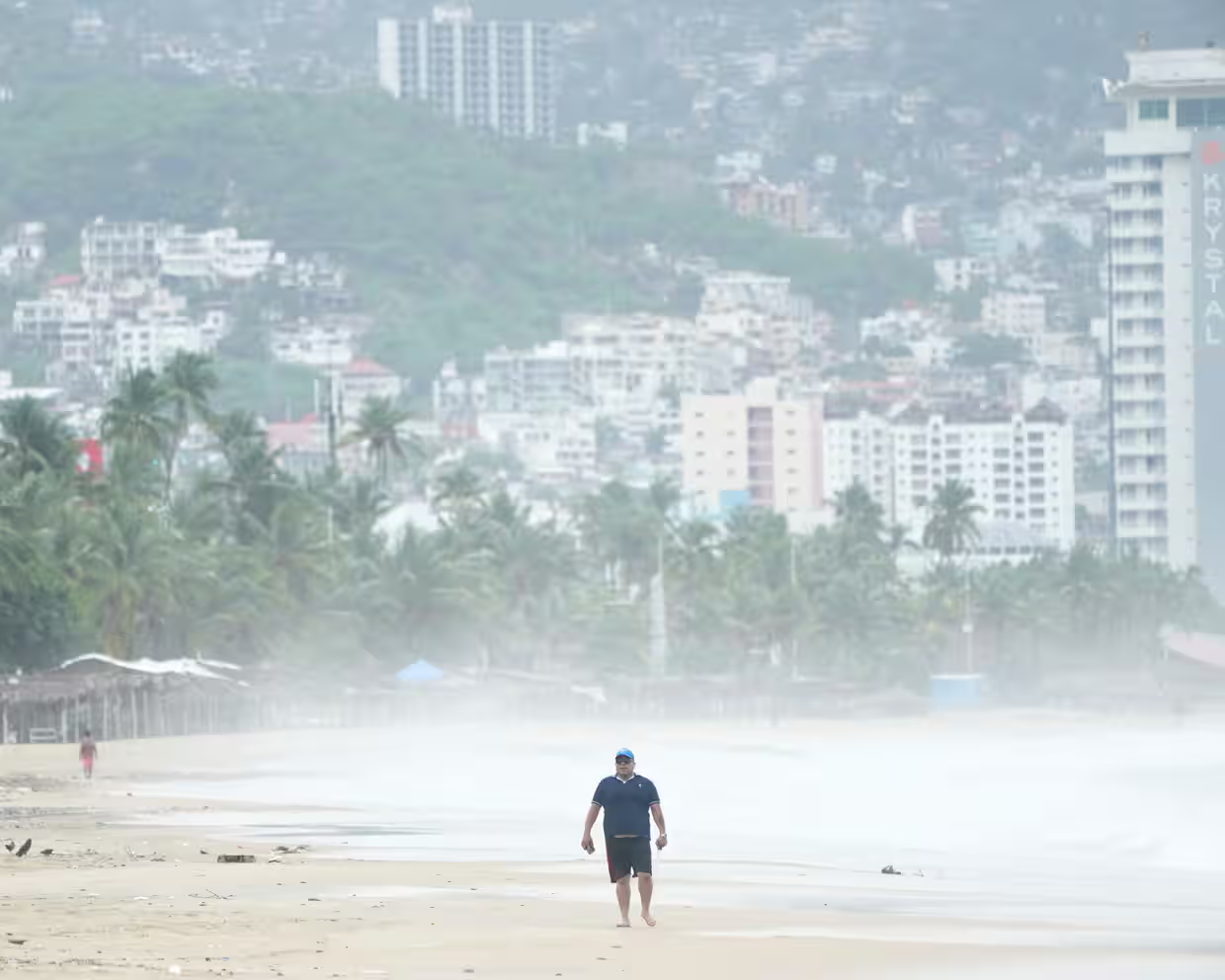 Tropical Storm Dalila brings flooding to Acapulco, while Hurricane Erick causes disruption in Oaxaca state
While the western Atlantic has experienced a quiet start to the hurricane season, the eastern Pacific has recently become fairly active, producing a tropical storm and a category 4 hurricane within a few days.
The first and weaker of these systems, Tropical Storm Dalila, developed into a tropical storm late last week. Although this storm stayed off the coast of Mexico and was relatively weak to other storms that have developed in this region, Dalila brought flooding and mudslides to the resort town of Acapulco, in western Mexico.

On Tuesday, Hurricane Erick formed in the eastern Pacific, marking the fifth named storm in the region. Erick rapidly strengthened off the west coast of Mexico into a category 2 hurricane on Wednesday, before transitioning into a category 4 hurricane on Thursday, with maximum sustained winds of about 140mph.
Despite having been downgraded to category 3 by the time it made landfall over the state of Oaxaca, sustained wind speeds still reached almost 130mph, causing major disruption. Large waves were produced by Erick, with the popular surfing spot Puerto Escondido seeing waves breaking at over 20ft (about 6 metres).
Up to 400mm of rain is expected to fall through the course of the hurricane’s passing, bringing further flooding and landslides to areas that were already affected by Dalila late last week and earlier this week. Forecasts indicate the hurricanewill deintensify as it pushes north-westwards across mountainous terrain in Mexico.
The tropical eastern Pacific is expected to continue to be active through the rest of June, with potential development areas being watched by the National Hurricane Center. In contrast, the Atlantic is expected to remain quiet for a time, but is still forecast to produce an above-average number of storms and hurricanes.

 The National Autonomous University of Mexico launches the strategy to nurture peace among higher education students, with UNESCO as a partner.
The culture of peace must be understood as a cross-cutting process that involves justice, inclusion, mutual respect, sustainability, and cooperation, not only in personal and family relationships, but also in social interactions, stated Leonardo Lomelí Vanegas, Rector of the National Autonomous University of Mexico (UNAM), during the launch of the strategy Cultura de paz: un Semillero Universitario (Culture of Peace: A University Seedbed).
This initiative, supported by the Ministry of Foreign Affairs, the Norwegian Centre for Conflict Resolution (NOREF), the Mexican Episcopal Conference, and UNESCO, aims to consolidate a culture of peace within the university community by fostering values and conflict mediation methods. It does so by connecting the work of academic staff across various university entities with new proposals, especially for younger students, to practice peaceful conflict resolution.

Among the key actions of the strategy, Lomelí Vanegas highlighted the establishment of a UNESCO Chair on the Culture of Peace; the creation of a course on Culture of Peace and Mediation, as well as a diploma program; the development of a violence diagnostic for each UNAM campus; a student essay contest; and a cultural and sports activities program. He also announced the First National Week of the Culture of Peace, scheduled to take place in September 2025.
At the signing of the agreement to create the University Program for the Culture of Peace and the Eradication of Violence—which formalizes the strategy—Lomelí Vanegas emphasized that it is a commitment to transform interaction frameworks and decision-making processes, and to prevent and address all forms of violence.


Peace is sown in the classroom
According to the UN Secretary-General’s Report on the Protection of Civilians in Armed Conflicts, there are at least 120 ongoing armed conflicts worldwide, affecting over 280 million people. In the face of this landscape, where violence, hate speech, and discrimination have intensified, hope remains.
“Violence is a culturally learned behaviour and, as such, it can be unlearned. Peace is not a passive opposite, but part of the same process. It is chosen and practiced with awareness and commitment. It also requires profound cultural changes, political will, and the active involvement of public and private institutions, as well as civil society,” said Lomelí Vanegas.
Cultivating peace, like agriculture, requires sowing seeds, watering, and caring for them to reap results. The key to cultivating peace is education.
Education is the only alternative to build and guarantee a culture of peace. The only path to peace is through dialogue, prevention, political solutions to conflicts, and bilateral relations between our nations.
“If we speak of building a culture of peace, it necessarily must begin with education. The great commitment of the Mexican government is through education. The well-being of everyone is a right, and we must work from classrooms and schools for a country with peace and free of addictions,” agreed Mario Delgado Carrillo, Mexico’s Secretary of Public Education.
Mexico: a key actor in peacebuilding
“Mexico is a pacifist country. As a signatory of the United Nations Charter, since the San Francisco Conference in 1945, Mexico supported establishing peace and international security as the UN’s main goal. The legacy of Mexican diplomacy has contributed to that culture of peace. However, today’s global reality shows that something has not been done right. The challenge we face to advance a culture of peace is enormous, and so are the opportunities,” said Juan Ramón de la Fuente, Mexico’s Secretary of Foreign Affairs, in a video message.
Among examples, the foreign minister highlighted the role of women in peacebuilding and peacekeeping. “There is solid evidence that women have been more effective in building peace and sustaining peace processes over time. This has been a key agenda we promoted when Mexico was an Elected Member of the UN Security Council: The Women, Peace, and Security Agenda, alongside the Netherlands, Kenya, and Norway. That is why we are also increasing the participation of women in diplomacy, betting on a feminist foreign policy.”
For her part, Rosa Icela Rodríguez Velázquez, Secretary of the Interior, who also congratulated UNAM on the strategy, emphasized the Mexican government’s peacebuilding initiatives and the role each person plays in achieving this common good.
“If each of us contributes a grain of sand to transform our beloved nation, we will achieve a better Mexico for our children, youth, and future generations. Mexico is not condemned to war; Mexico is destined for peace,” she said in her video message.
Dag Nylander, Director of the Norwegian Centre for Conflict Resolution (NOREF), praised the work conducted by the governments of Mexico and Norway since 2023 to explore dynamics and solutions to conflict, and celebrated UNAM’s initiative as a continuation of that collaboration.
“We are committed to strengthening multilateralism and supporting the United Nations system in which we are all represented. The initiative launched today plays a complementary role. At NOREF, we are fully committed to supporting initiatives that advance conflict resolution, and interregional collaboration is key to this goal,” he stated.
The presentation of the strategy “Culture of Peace: A University Seedbed” was also attended by Elena Centeno García, current President of UNAM’s Governing Board; Mario Luis Fuentes Alcalá, President of the Board of Trustees; former UNAM rectors José Sarukhán Kermez, José Narro Robles, and Enrique Graue Wiechers; Roberto de León Huerta, Chief of Staff to the Secretary of Foreign Affairs; and Andrés Morales, UNESCO Representative in Mexico, among other figures from civil society organizations, universities, and institutions working to promote a culture of peace.
Mexican authorities rescue over three thousand trafficked baby turtles
 This handout picture released by the Mexican Federal Environmental Attorney’s office shows hatchlings of hicotea turtles (Trachemys venusta) rescued in San Cristobal de las Casas, Chiapas state, Mexico on June 19, 2025. Authorities rescued 3,427 turtle hatchlings and arrested a man accused of illegal wildlife trafficking in the Mexican state of Chiapas
MEXICO CITY, Mexico (AFP) — Mexican authorities said Friday they had rescued over 3,400 protected baby turtles stuffed into cardboard boxes set to be trafficked.
During a roadblock in the southern state of Chiapas, agents found the critters “in overcrowded conditions” in boxes in a vehicle whose driver was arrested on wildlife trafficking charges, the environmental protection prosecutor’s office said in a statement.
The baby animals were freshwater Meso-American sliders, native to Mexico, Central America and Colombia.

“The specimens were transported without documentation proving their legal origin, which constitutes a violation of environmental regulations,” the prosecutor’s office said.
The turtles were taken to a specialised unit for rehabilitation and to determine whether they can be released back into the wild.