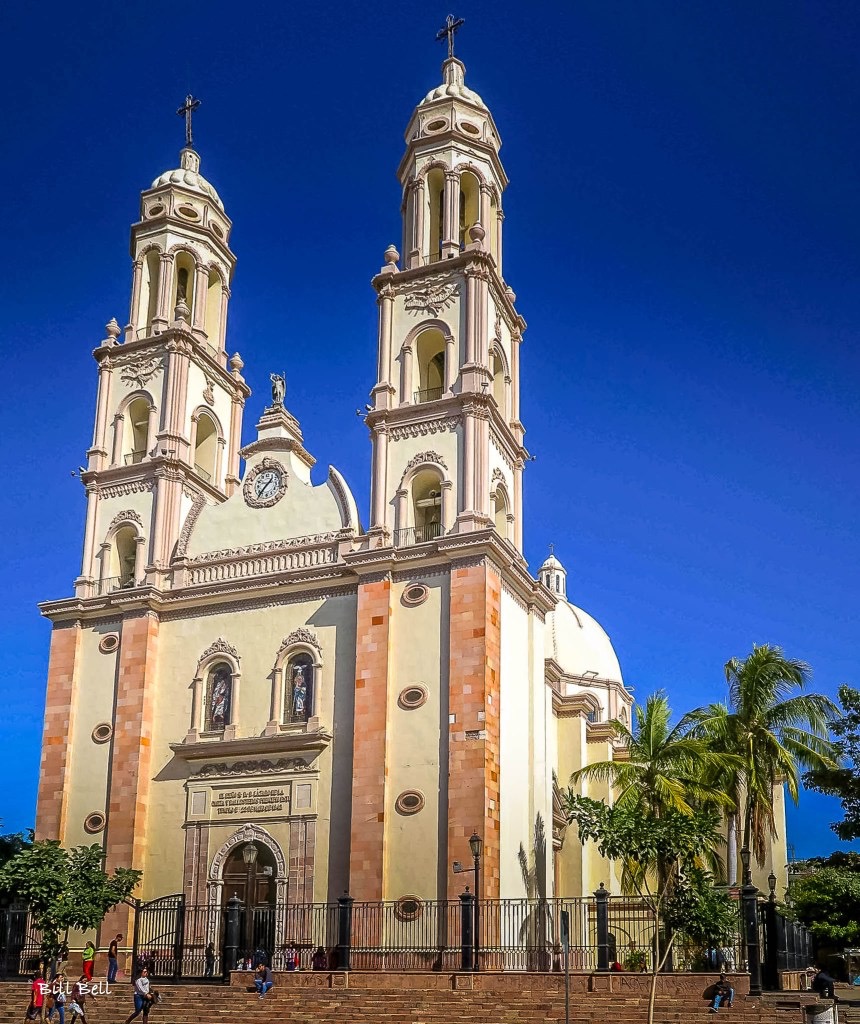
Culiacán, Sinaloa is the capital city: cathedrals, cartels and the “Saint of the Narcos.”
It’s under 1,000 kilometers (605 miles) from the Nogales border, yet worlds away in custom and culture. Nearly 1 million people live here.
Consular warnings say to avoid this place. Even so, curious travelers want to explore the Narco Robin Hood shrine. There is also an amazing cathedral, extensive shopping centers and parks.
A visit for the brave or foolish. Please check the current consular and travel advisories before you decide.
More Mexico road-trip stories and destinations are right here at DriveMexicoMagazine.com.
Music by Julius H., Pixabay.
Would you go? Tell us what you’d want to see first.
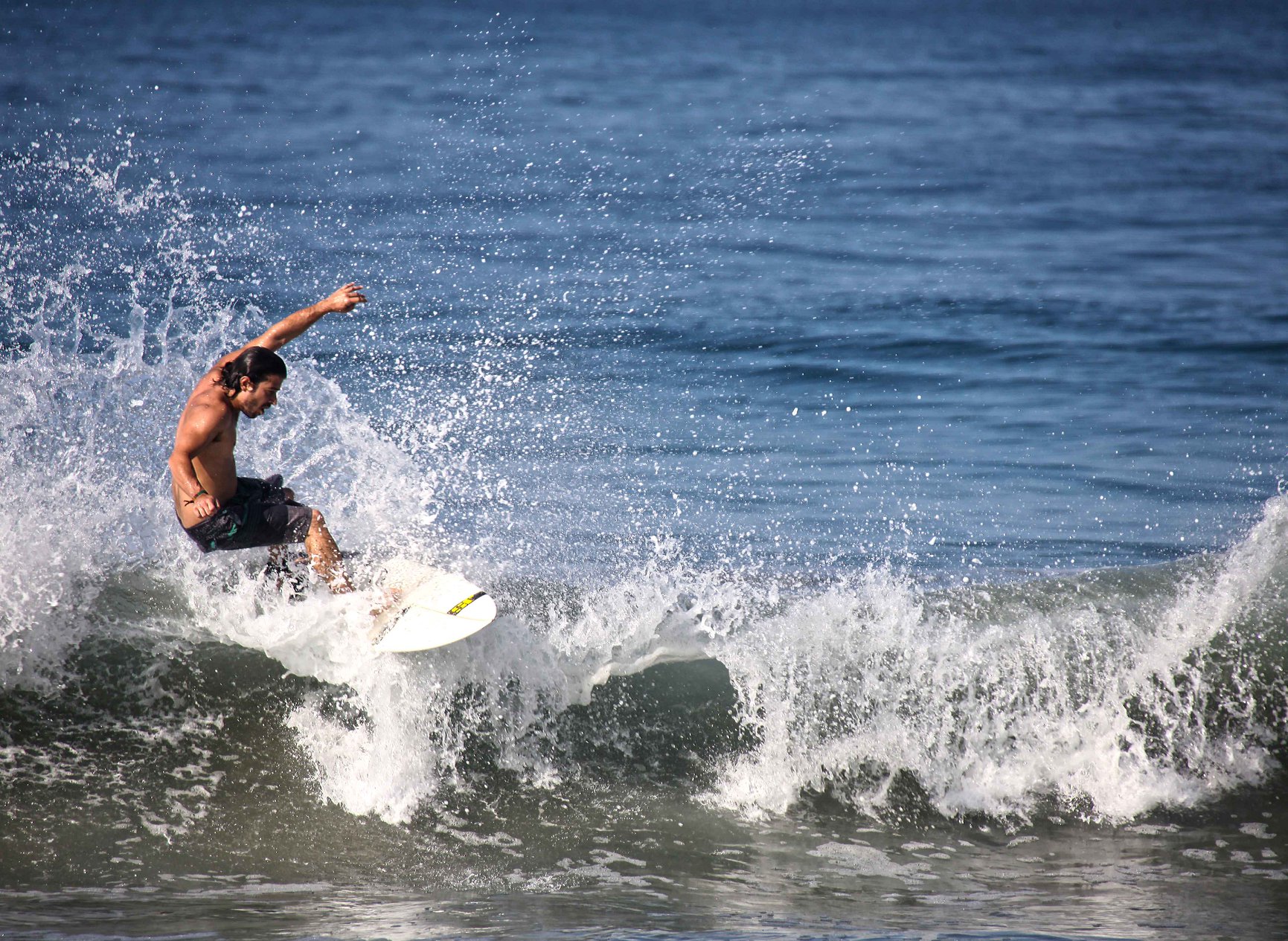
Sayulita is a young person’s mecca along a coastline of retirees and family communities. Surf schools, private lessons and rentals, rustic “authentic” accommodations, and beginner and intermediate surf breaks.
It isn’t Puerto Escondido’s Mexican Pipeline, but Sayulita gives beginner and intermediate surfers plenty to work with.
Away from the water, we like to stroll the cobblestone streets, look over the handicrafts and enjoy the market. There are charming clothing shops, art galleries and some unique bars.
Getting there: 1,554 km (965 miles) from the Nogales border, or 40 km (25 miles) from Puerto Vallarta.
More Mexico road-trip stories and destinations are right here at DriveMexicoMagazine.com.
Music by TUNETANK, Pixabay.
Have you surfed or stayed in Sayulita? Tell us what you’d do first.
Puerto Escondido and Zicatela, on the Oaxaca coast, is home to the Mexican Pipeline, famous for its surfing competitions every year in November.
It’s a laid-back town with small restaurants and hotels. Think surfing, dreadlocks, seafood and beach.
Puerto Escondido is close to 3,000 km (1,760 miles) from Nogales, or under 200 km from Oaxaca City. The name means “hidden port,” and it’s a relaxing haven.
Planning a drive to the Oaxaca coast? Browse more destinations and road-trip reels here on Drive Mexico Magazine.
Have you surfed or stayed in Puerto Escondido? Tell us in the comments.
Photography by Bill Bell. Music: “Retro Surf Rock” by Tunetank, Pixabay.
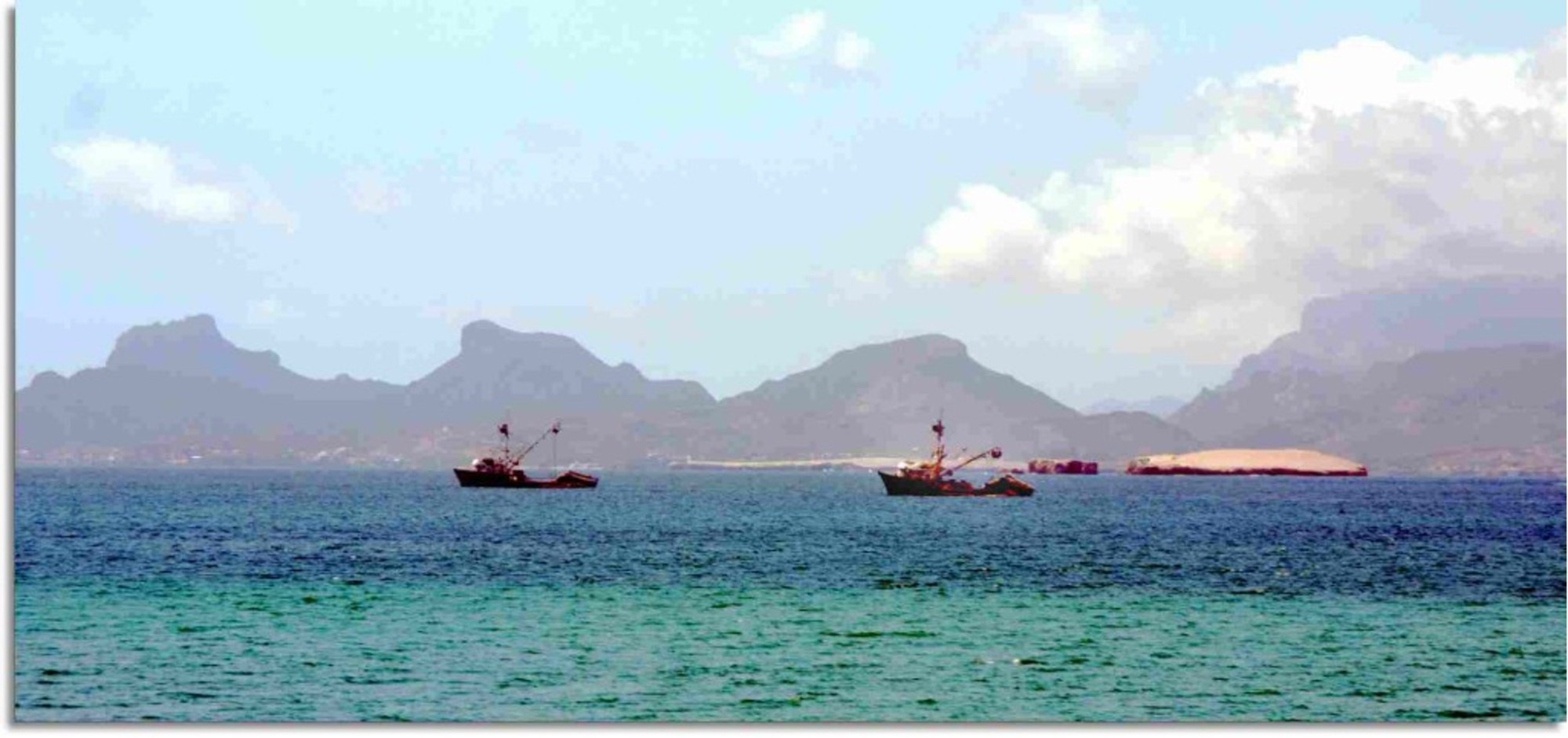
Guaymas, Sonora is known as “the port of ports.” It’s often the first night stay for travellers driving south from Nogales. It’s only 420 km (262 miles), but the border and the KM 21 permit stop eat up the time.
Guaymas is an industrial and shrimp-fishing port, with port construction, maintenance and shipping. It’s also home to maquiladora plants producing clothes, electronics and auto parts for export markets.
San Carlos is the tourist town next door, established in 1963: an adult playground with a golf course, bars, restaurants and marinas for water sports and scuba diving.
Guaymas remains a prominent port city. There’s industry, but it’s also a historic city rich in Mexican history and culture.
Planning a drive south from Nogales? Browse more destinations and road-trip reels here on Drive Mexico Magazine.
Where do you stop for your first night? Tell us in the comments.
Photography by Bill Bell. Music by IKOLIKS, Pixabay.
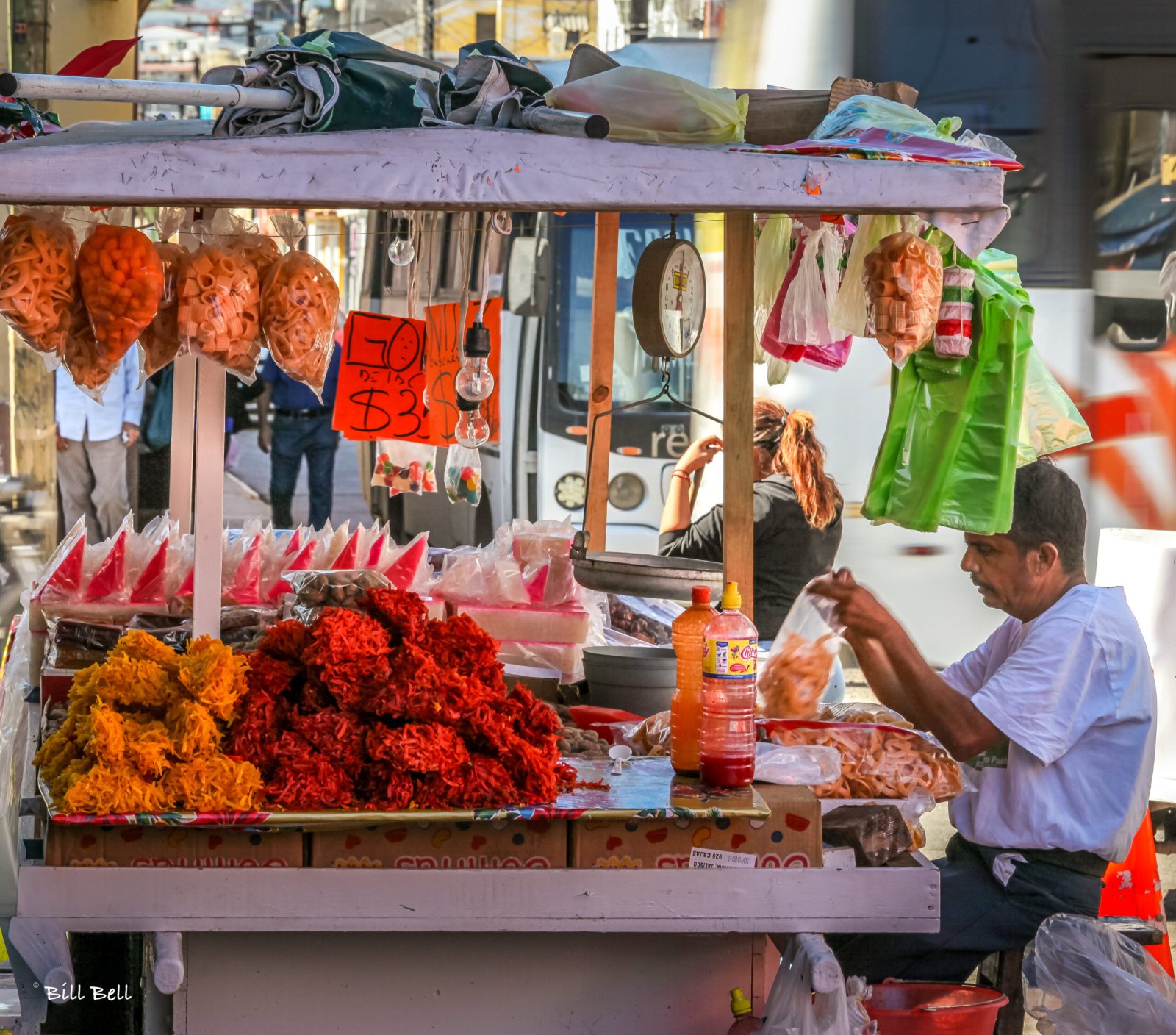
Of course, food is everywhere you go. But in Mexico, they take it to the next level.
Walk down a street, cross a plaza, wander through a market or settle into a chair on the beach, and food is usually close by. Someone is cooking it, carrying it, arranging it for sale or offering you something you hadn’t planned on eating.
Dorothy and I have spent decades travelling Mexico, and food has been a constant part of those journeys. Looking through these photographs, what strikes me is how much of it happens out in the open. You see the work, meet the seller and watch your meal being prepared.
A cooking stand beneath a red canopy in Mexico City. Photograph by Bill Bell.
A kitchen where you find it
A small cooking stand sits beneath a red canopy, with smoke drifting past the chairs. In another photograph, two men work beside a pickup truck, steam rising from the food between them. There are utensils, ingredients and a bag of limes within reach.
Two men prepare food beside a pickup truck. Photograph by Bill Bell.
These are practical arrangements. A place to cook, somewhere to prepare the ingredients and enough room to serve a customer. For the person passing by, they are an invitation to stop.
The photograph of the cook working over a hot grill brings us closer. His attention is on the food. Behind every quick meal bought on the street is someone doing the shopping, preparing the ingredients, tending the heat and cleaning up afterwards.
A cook tends a hot grill. Photograph by Bill Bell.
The market spills into the street
Some sellers have a stall. Others have a cart, a basket or a few crates arranged along a wall.
Against an ochre-coloured building, women sit beside their produce, the goods spread out where customers can see them. Elsewhere, a shaded market passage is crowded with bananas and other fruit.
Produce sellers sit beside their goods along an ochre-coloured wall. Photograph by Bill Bell.Fruit fills a shaded market passage. Photograph by Bill Bell.A colourful produce display brings the market into the street. Photograph by Bill Bell.Vendors sort and arrange a generous display of fruit. Photograph by Bill Bell.
Then there are the pineapples. In one photograph, they fill the foreground beneath the gaze of a man in a cowboy hat. In another, they are stacked across a cart under a red-and-white canopy. The display makes its own announcement.
Pineapples fill the foreground beside a seller in a cowboy hat. Photograph by Bill Bell.Pineapples stacked beneath a red-and-white canopy. Photograph by Bill Bell.
These photographs also show why I enjoy markets. There is plenty to look at, but there are people to notice as well: waiting for customers, sorting fruit, making a sale or taking a moment between jobs.
Even the beach has a menu
One of my favourite scenes is the food cart on the sand, its skewers lined up beneath an umbrella, with the sea and a small island behind it.
A beachside food cart, with skewers beneath an umbrella and the sea behind it. Photograph by Bill Bell.
You could hardly ask for a clearer example of food finding its way to wherever people gather. No dining room is required. The beach provides the setting.
And there is always something sweet
A seller stands behind a display of brightly coloured spiral lollipops. Another cart is crowded with snacks and fruit, with its operator tucked into the small working space behind the counter.
A sweets seller stands behind brightly coloured spiral lollipops. Photograph by Bill Bell.A sidewalk stall displays snacks beneath an umbrella. Photograph by Bill Bell.
Colour is part of the attraction. So is convenience. You’re walking past, something catches your eye, and suddenly you’re stopping. Not every purchase needs to become a meal.
The people behind the food
I would finish this collection with the woman seated beside her basket, wearing a white hat and a turquoise sweater.
A woman in a white hat sits beside her basket. Photograph by Bill Bell.
After the crowded displays, smoke and bright colours, it is a quieter photograph. It brings the story back to the individual. Food is a livelihood. Every cart, basket and market stall represents someone’s work.
For those of us travelling through, these encounters become part of how we remember a place: a roadside stop, something bought through a market stall, a meal prepared a few feet away.
In Mexico, food gives you plenty of reasons to stop. These photographs are about some of the people who make those stops worthwhile.
La Peñita de Jaltemba is a small coastal town on the Riviera Nayarit, and it’s the best of small, authentic Mexico. It’s about an hour’s drive, 75 km (48 miles) north of Puerto Vallarta.
It’s the service hub for the tourist towns of Los Ayala and Rincón de Guayabitos, with a bank, hardware stores, grocery stores, vegetable markets, a library and a post office.
La Avenida is the tree-lined main street that runs from the highway to the ocean. It’s filled with restaurants, small grocery stores and specialty shops, and it’s pure Mexican. Parades and celebrations begin on this avenue.
Every Thursday morning the central tianguis, a travelling market, sets up. You’ll find everything from vegetables to makeup, stove parts to jewelry, plastic ware to handcrafted treasures. Don’t miss it.
And eat at Hinde and Jaime’s Restaurant for the best margarita in Mexico!
Planning a drive to the Riviera Nayarit? Browse more destinations and road-trip reels here on Drive Mexico Magazine.
Have you been to La Peñita? Tell us about it in the comments.
Photography by Bill Bell. Music by Drippeados, Pixabay.
Tapachula is as far south as you can drive in Mexico. It’s the southernmost city on the Pacific coast, over 3,000 km (2,000 miles) from Nogales on the coastal highway, and only 40 km (24 miles) from the Guatemalan border.
The Aztecs established the city in the 13th century. Then in the 19th century, coffee plantations brought significant immigration, and Chinese and German cultures both shaped the city’s growth.
This is the centre of a rich farming region known for internationally acclaimed coffee and cocoa, and its port handles trade with Central America and the world. It has the highest per capita income in Chiapas, and you can see it in the malls, big box outlets and health facilities.
For many travellers, Tapachula is the jumping-off point for Central America.
Planning a drive to southern Mexico? Browse more destinations and road-trip reels here on Drive Mexico Magazine.
Have you driven this far south? Tell us about it in the comments.
Pacific storms lead this week’s news, alongside Tara A. Spears’ look at the Xolo dog, the traditions behind La Catrina and cultural events around Mexico.
October 11–17, 2026 · News and culture
1. Trudy keeps the Pacific coast on alert
In the October 17, 3 p.m. CST advisory, Trudy was a Category 2 hurricane. Coastal residents and travellers should check current warnings before setting out. The danger includes heavy rain, flooding and rough seas beyond the hurricane’s centre. Read the latest National Hurricane Center advisory.
2. Simón dissipates; recovery continues
NOAA’s final October 16 advisory reported that Simón had dissipated. That does not establish that affected roads, beaches or businesses have reopened. Check conditions locally before travelling. NOAA storm information.
3. Tara’s story: a companion in life and beyond
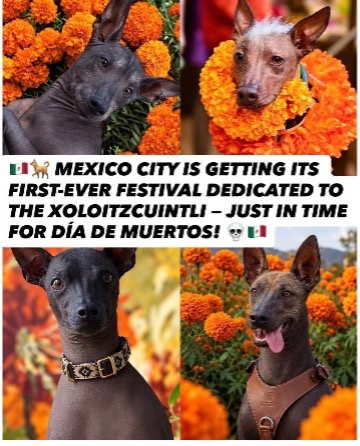
In “Xolo: Man’s Best Friend Even in the Afterlife,” Tara A. Spears explores the dog’s place in Mexican traditions and the ways communities remember beloved pets. Her story also includes local Day of the Dead programmes. Read Tara’s illustrated story.
4. La Catrina, through Bill Bell’s camera
Bill’s photo essay looks at the elegant skeleton seen across Mexico as Day of the Dead approaches. Sixteen photographs accompany the history behind this familiar figure. See the photographs and story.
5. Cervantino reaches its final weekend
Guanajuato’s 54th Festival Internacional Cervantino runs October 3–18, with France as guest country. Check the official programme for remaining performances and tickets. Official festival programme.
6. INAH offers October cultural outings
INAH’s October cultural-travel programme includes Hidalgo, Morelos, Querétaro and Tlaxcala, with visits focused on history, archaeology and art. Confirm remaining departures and availability before making plans. Read INAH’s programme.
7. Mexico announces plans for children’s online protection
President Claudia Sheinbaum announced plans on October 14 to require digital platforms to protect minors from violent and sexual content. Implementation details remain important for families and platforms. Read the report.
What drivers should know this week
Check the latest storm bulletin and local road reports before leaving. Allow extra time, avoid flooded crossings and follow official closures. Reconsider coastal trips when authorities advise against travel.
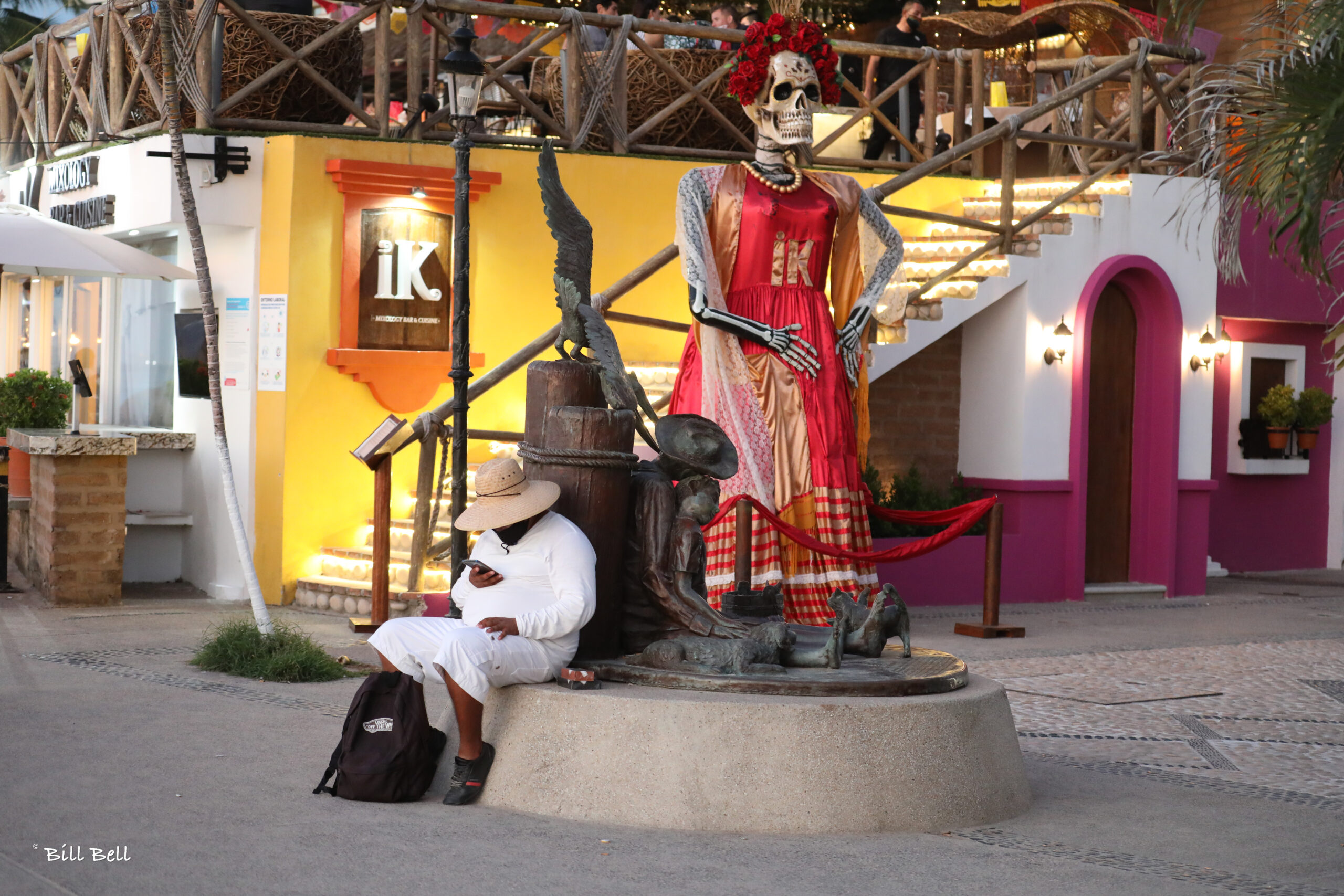
A man checks his phone beneath a towering Catrina in a red dress. Just another scene on a Mexican street. Photograph by Bill Bell.
Words and photographs by Bill Bell
One of my favourite photographs of La Catrina has very little action in it. A man sits checking his phone. Behind him, an enormous skeletal woman in a long red dress towers over the pavement. He has his business to attend to. She has hers.
That photograph says more about the place these figures occupy in Mexico than a whole parade might. Nobody needs to stop what they are doing because a skeleton is standing beside them. She belongs there.
I have kept finding her on my travels: outside shops, in public squares, painted on walls and dressed for an occasion that may or may not be happening. As Día de los Muertos approaches, the sightings multiply. Hats grow wider, dresses get more elaborate, and another familiar face turns up around the corner.
A broad, lace-trimmed hat and purple feather boa frame a painted skeletal face. La Catrina can be quite the dresser. Photograph by Bill Bell.
They’re Everywhere — Even When Nobody Is Celebrating
Look beyond the organised celebrations and there is another story. These figures share the street with parked cars, shop displays and people getting on with their day. That is often where I find the photograph I want.
A skeletal couple keeps company beside a parked car: he wears a dark hat, while she favours a pink wig and a bright red gown. Photograph by Bill Bell.
The couple beside the car looks ready for an evening out. In a shop doorway, another figure has so much colourful company that it takes a moment to pick her out. The surrounding shelves and walls are almost as busy as her outfit.
A skeletal figure in a decorated sombrero stands among a shop’s densely packed, colourful crafts. Photograph by Bill Bell.
Then there is the skeleton sharing a bench with a visitor. One arm stretches along the back, as if the seat has been saved for someone. It is an invitation to join in, and a photograph waiting to happen.
A visitor shares a bench with a grinning skeleton in a broad sombrero. There is room for the living, too. Photograph by Bill Bell.A large skull face looks out from the entrance of a red building, bringing calavera imagery into the streetscape. Photograph by Bill Bell.
The lady beneath the hat
It is easy to call every dressed-up skeleton La Catrina. Strictly speaking, they are not all the same character. La Catrina is the elegant skeletal woman associated with the work of José Guadalupe Posada and Diego Rivera. Calavera means skull, and the word also belongs to a much wider world of skeletal imagery and satire. The skull on a doorway, the painted face on a wall and the fellow on the bench belong in this story without all having to be Catrinas.
Posada’s early twentieth-century print, known as La Calavera Garbancera, shows a skull beneath an extravagant hat. Its satire is commonly read as a jab at social pretension and the desire to appear European. In 1947, Rivera gave the figure an elegantly dressed body and a central place in his mural Dream of a Sunday Afternoon in the Alameda Central, helping establish La Catrina as we recognise her today.
A mural places an elaborately hatted Catrina among historical figures, including Frida Kahlo. Photograph by Bill Bell.
Knowing that history adds something to the pleasure of finding her. The finery is part of the joke. However impressive the hat, there is still a skull underneath it.
A broad hat, rope-like hair and a purple collar give this skeletal figure a character all its own. Photograph by Bill Bell.
No shortage of imagination
What keeps me taking photographs is the variety. Just when I think I have seen every possible outfit, along comes a skeleton in purple with a red-and-white crest of hair. A little farther on, someone has gone in the opposite direction: flowers, a long veil and an enormous hat.
A red-and-white crest of hair and a purple outfit give this skeleton a distinctly punk appearance. Photograph by Bill Bell.A slender skeletal figure wears a floral dress and an oversized, veiled hat, with one hand raised beside her face. Photograph by Bill Bell.
The painted versions are just as inventive. A face recognisable as Frida Kahlo is divided between flesh and skull. Another work surrounds a woman’s painted face with roses and smaller calaveras. These artists draw from overlapping images of Mexico; they are not simply repeating one old print.
A wall painting divides Frida Kahlo’s face between a living portrait and a skull, beneath a crown of flowers. Photograph by Bill Bell.Red roses and smaller skulls surround a woman with colourful calavera-style face paint in this artwork. Photograph by Bill Bell.
Out in the squares, the figures get room to spread out. One throws both arms into the air in front of Guadalajara’s cathedral. The buildings make a useful counterpoint: solid stone behind a skeleton that seems determined to enjoy itself.
With both arms raised, a brightly dressed skeletal figure strikes an exuberant pose near Guadalajara’s cathedral. Photograph by Bill Bell.
As November approaches
The build-up to Día de los Muertos brings more of these encounters. People become part of the picture, too. Hats, flowers, face paint and a great deal of patience turn a familiar face into something quite different.
Flowers crown a woman’s carefully painted face: a living interpretation of La Catrina, in purple and gold. Photograph by Bill Bell.
In another photograph, two children stand beside a tall, dressed-up skeletal figure. I like the contrast in scale, and the ease with which they share the picture. There is room here for playfulness as well as ceremony.
Two children pose beside a tall skeletal figure wearing a hat, an orange boa and a pale skirt. Photograph by Bill Bell.
But the public spectacle is only part of Día de los Muertos. At its heart is remembrance of people who have died. Many families prepare ofrendas with photographs, candles, marigolds, food and drink, and visit or decorate graves. November 1 and 2 are central dates, though the timing and customs vary from community to community. La Catrina’s modern fame sits alongside traditions with much older roots.
A smiling skeleton does not tell us that grief is easy, or that everyone in Mexico thinks about death in the same way. What these photographs show is how much space artists and ordinary streets make for its image: sometimes solemn, sometimes elegant, sometimes very funny.
A flower-trimmed skeletal figure shares the frame with the twin towers of Guadalajara’s cathedral. Photograph by Bill Bell.
That is why I keep stopping. There is always another expression, another unlikely outfit, another small scene taking place around her. As November approaches, La Catrina becomes harder to miss. But she does not need a parade to get my attention. Sometimes all it takes is a man checking his phone and a very tall woman standing behind him.
By Bill Bell | October 13, 2026 Storm information based on NOAA’s 09:00 UTC advisory, October 13
Puerto Vallarta and Riviera Nayarit begin Tuesday with an offshore hurricane still demanding attention, while the airport operator has brought forward its reopening schedule.
Hurricane Simon remained a Category 1 hurricane in NOAA’s early Tuesday advisory, with maximum sustained winds of approximately 145 km/h (90 mph). Its centre was near 20.6°N, 107.2°W, moving slowly northwest.
NOAA continued a hurricane warning for Islas Marías and a hurricane watch for part of western Mexico’s coast. The forecast kept Simon offshore in the near term, with a possible approach to the mainland later this week. Heavy rain, flooding, mudslides, dangerous surf and rip currents remained concerns. Source: NOAA/National Hurricane Center, Discussion 24.
What this means for Puerto Vallarta and Riviera Nayarit
The offshore position is encouraging for communities concerned about the hurricane’s strongest winds. Our assessment is that the immediate focus should remain on coastal water conditions, local flooding and safe access, rather than treating the storm’s distance from shore as an all-clear.
Conditions can differ considerably between communities. An airport reopening does not establish that every beach, road or neighbourhood is safe.
Puerto Vallarta airport: reopening brought forward
Grupo Aeroportuario del Pacífico announced a two-stage reopening, replacing its earlier plan to keep the airport closed until 8 a.m. Tuesday.
Official aircraft operations resumed at 2:30 p.m. Monday, with opening to all flights, including commercial services, scheduled for 12:01 a.m. Tuesday. Individual airline schedules remain subject to confirmation. Passengers should check directly with their airline before travelling to the terminal. GAP’s reopening announcement; La Jornada’s report detailing the timetable.
San Blas: coastal flooding reported
N+ reported Monday that storm-driven seawater flooded at least three neighbourhoods in San Blas. That report underlines why communities farther north along Nayarit’s coast must continue following local instructions even as attention shifts away from Puerto Vallarta. Source: N+, October 12 report.
Roads and local services
We have not verified a comprehensive reopening notice for the coastal road network. Travellers should confirm their particular route before departure and should never drive through floodwater or around a closure.
Likewise, earlier school, beach and business restrictions should not be assumed lifted without a new local announcement.
For residents and visitors, the practical message remains: confirm flights, check local access, respect coastal restrictions and continue monitoring official updates. Simon remains an active hurricane.