
The yearly migration of monarch butterflies might best be described as a round-trip relay race.
Multiple generations of butterflies are born, reproduce and die along the journey. The final and most resilient generation makes its southernmost stop in the high-elevation forests of Central Mexico.
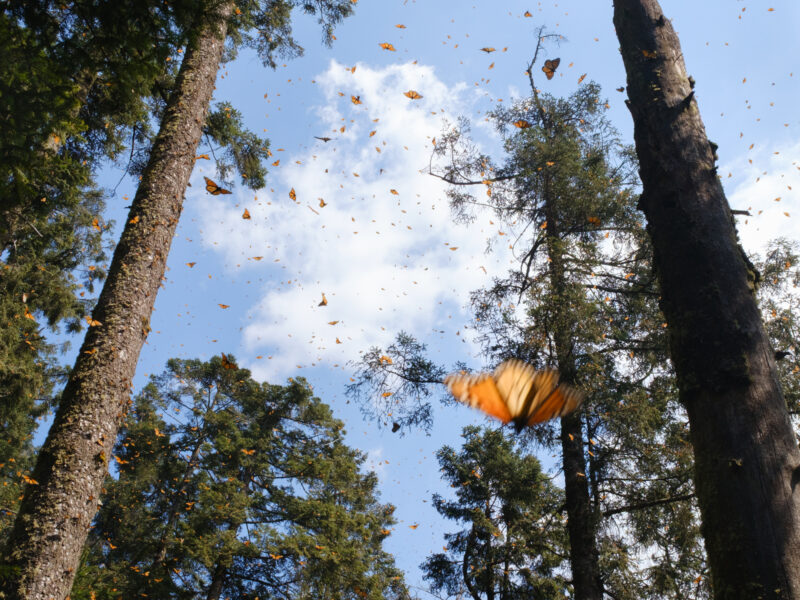
Here, after a 3,000-mile voyage from Canada, millions of monarch butterflies rest in the canopies of oyamel fir trees.
Eastern monarchs are the only butterflies in the world that migrate over such long distances and in such a coordinated way. They arrive by the tens of millions in central Mexico in November, overwintering here until March.
“The monarchs we are going to see are going to mate. And then in a couple of weeks, they are going to go to Texas to deposit their eggs,” butterfly expert Teresa Cerapia explains as she takes me to see the butterflies one February afternoon.
“It’s Texas’s job to have enough of that milkweed in a large enough area for her to lay her eggs,” she adds. “Once she lays her eggs, the monarch soon dies and her offspring are born.” Those offspring will mark the first generation of monarchs born on the species’ annual journey.
We’re heading up a winding mountain road to the San Pablo Malacatepec community butterfly area near the Mazahua community of Villa de Allende in the State of Mexico.
Part of the larger Cerro Pelón Sanctuary, these forested hills were once a logging hub but have been formally protected by the Mexican government since 2000. It’s one of a handful of scattered sanctuaries within the larger UNESCO-protected Monarch Butterfly Biosphere Reserve, which spans around 200 square miles in the states of Michoacán and Mexico.
A former member of the reserve’s advisory council, Cerapia currently works as a sustainable tour operator and conservationist with the nonprofit Nación Verde, leading butterfly-lovers on excursions like this one. The proceeds from these tours go toward reforestation and community development.
We ascend higher into the mountains, dodging potholes as Cerapia’s SUV kicks up dust. At 11,000 feet above sea level, the air here is fresh and cool, especially compared to Mexico’s capital.
From the window of her SUV, Cerapia points at towering evergreen trees: the oyamel or sacred fir, as well as some cedar and pine. She also points out the monarch’s main predators, one above and one below: the crow and the mouse.
Although the butterflies here will begin the species’ journey north, they’re technically considered the last generation from the previous journey. The so-called first generation of monarchs are born on the journey, in places like Texas in the Southern United States.
“The first-generation butterflies will live for about a month,” Cerapia explains. “From the moment they’re born, they’ll start reproducing and migrating north further into the United States.”
“Their mission is to reach the Great Lakes,” she adds — “but many won’t make it.”
The cycle repeats for a second and third generation. There’s sometimes also a fourth, depending on environmental conditions that year. Each one lives for about a month, traveling north, reproducing and dying.
Then comes the anomaly, the final so-called Methuselah or super generation.
From birth, these monarchs instinctively know that they must embark on a long journey south. They are hardwired to feed and conserve energy for their migration. They won’t reproduce until spring, after they overwinter.
These Methuselah butterflies are the only monarchs with the longevity and endurance to fly 3,000 miles from Canada and the U.S. Their name comes from a patriarch in the Bible’s Book of Genesis, who was said to have lived to 969 years old.
They travel for six months and live for nine — far outlasting the generations before them. “These are the butterflies we’re going to see right now,” Cerapia says as we get out of the SUV to make the rest of the trek on foot.
Thousands of butterflies cluster on the trees, resting. They’re difficult to see at first, camouflaged against bark by the dull brown undersides of their wings.
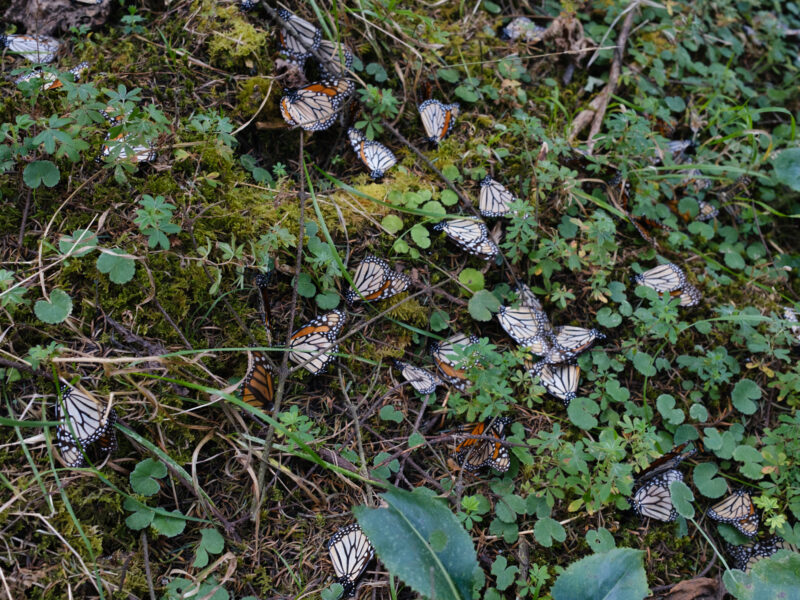
Several hundred monarchs dot the soil, having fallen down from exhaustion and cold. They are not dead but merely waiting for the sun to warm up the woods, giving them one of their many nicknames: the children of the sun.
“When the sun hits them,” Cerapia says, “they fly.”
Cerapia walks through the trees. The scent of resinous oyamel seeds fills the air, a delicate piney aroma mixing with smells of damp wood and fresh dirt.
Cerapia was born in the nearby town of Zitácuaro, Michoacán. “When I was a little girl, I would be playing outside, and the sky would get dark from the clouds of monarchs arriving,” she says. “Now, they come more in spurts. There are less of them because of climate change.”
Monarchs get most of their nutrition from the milkweed plant, on which they lay their eggs. They also feed on the nectar of flowers like Mexican sunflower, aster and goldenrod.
A University of Ottawa study from January showed that even a slight temperature increase can reduce the nutritional content of floral nectar — possibly leading to massive population loss for monarch butterflies.
Also in January, the National Wildlife Federation estimated that eastern monarchs have a 48% to 69% chance of going extinct in the next 60 years. The situation is even more dire for the western monarch, with a 98% to 99% probability of extinction in the same time frame. Western monarchs breed west of the Rocky Mountains and typically overwinter in southern California. Both populations have also seen recent disruptions in migratory patterns due to climate change.
To combat these pressures, the three countries on the eastern monarch’s migration path have each committed to taking steps to help conserve monarchs. The U.S. and Canada are tasked with protecting milkweed, the only plant on which the monarch butterfly lays its eggs.
“If this plant disappears, the monarch has nowhere to lay its eggs,” Cerapia says. “And then what happens? They disappear.”
Mexico’s duty is to preserve the oyamel forests that comprise the butterflies’ winter habitat.
That’s why advocates say anti-logging measures are so crucial. Cerapia pointed out trees marked with tape, indicating where butterflies have roosted in migrations past.
In 2000, the Mexican government formally declared this area protected, banning logging. Locals needed to find a way to adapt to the new regulations.
“A lot of communities didn’t agree, but they stopped their logging activities,” Cerapia says. It helped that new conservation jobs soon cropped up from the government as well as nonprofits like Alternare, Fondo Mariposa Monarca, the World Wildlife Fund and Nación Verde. Much of the work involves firebreaks, controlled burns to clear out dead growth and fallen branches that could worsen wildfires.
“Forests sometimes get sick and need to heal,” Cerapia says. “As they say about the phoenix rising from the ashes, the forest does too.”
Despite dire predictions and dwindling numbers, the eastern monarch continues its great migrations, for now at least.
A few hours’ drive away at the Sierra Chincua Monarch Butterfly Sanctuary in Michoacán, tourists for a small fee can follow a public trail up the mountains to see the butterfly colonies.
Some ride small horses to make the steep journey easier. Among the visitors this day are Mexican families, international travelers and local teens on a school field trip.
After a two-hour hike up the mountain trail, we reach our destination, a crest of oyamel firs high up in the mountains.
Around noon, the sun warms up the roosting butterflies.
As they awaken, thousands flutter into the blue sky. It’s as if the trees themselves are splintering into a million little orange fragments.
The monarchs land on people’s shoulders. No one speaks. The only sounds are the soft rustlings of butterfly wings. Even the local guides who make this trip dozens of times a week seem to be in awe.
Soon, the Methuselah monarchs will leave this forest. In a few months, a future generation will return to this same spot as if by miracle. And so the process will continue, year after year, as long as this forest remains and the monarch butterfly survives.