“Is our route clear?” is one of the most important questions travelers ask before crossing into Mexico. The answer requires checking the specific roads you plan to drive—and checking again as your trip progresses.
An announcement that a blockade has ended, or a traveler’s trouble-free drive yesterday, does not guarantee the same conditions today. Here are useful sources to bookmark.
Guardia Nacional: highway incident alerts
Guardia Nacional’s highway alerts report incidents affecting traffic on federal highways. Look for your road number, nearby towns, direction of travel and kilometer marker. Always check the date and time, then look for a later reopening notice.
CAPUFE provides information about traffic conditions, tolls and assistance on roads it operates. Contact 074 within Mexico or check its official account. CAPUFE does not operate every Mexican toll highway; for other sections, check the operator listed on your toll receipt or roadside signs.
Check Mexico’s Servicio Meteorológico Nacional for forecasts and warnings along your route, including overnight stops. Weather at your destination may be very different from conditions on the roads getting there.
Use Waze alongside official reports to check congestion and reported closures. A clear map should not be treated as confirmation that a road is safe or that every incident has been reported.
Ángeles Verdes: roadside help and travel information
For mechanical assistance and tourist information, call 078 within Mexico. Ángeles Verdes can assess your location and arrange assistance where its service coverage applies.
And of course, check our Facebook group, On the Road in Mexico, for updates from drivers currently on the road. Look for recent reports with the date, time, highway and direction of travel. Member reports describe individual journeys and should be checked alongside official alerts.
How to check your specific route
Write down your border crossing, highway numbers, destination and overnight stops. Check each day’s section the evening before and again before departure.
For travelers crossing Nogales and heading south on Highway 15/15D, check each section through the states you will actually travel, rather than relying on a general statement that “15D is clear.”
When asking for information or sharing a report, include the date, approximate time, road, direction and nearest town or toll plaza. Those details make a report far more useful to the next traveler.
Save these links and telephone numbers before leaving. Social-media pages may require a login, so keep more than one way to check conditions.
Published October 24, 2026. This week’s English-language roundup brings together reporting from Nayarit’s coast and capital, with source links for each item and a look ahead to the Day of the Dead celebrations.
San Pancho: Punta Paraíso remains the leading coastal story
Heavy surf and erosion have damaged the beachfront Punta Paraíso development. Spanish-language coverage describes evacuations, a partial collapse and calls for intervention. Accounts differ on the extent of the damage; readers should not interpret the reports as confirmation that the entire complex has fallen.
The National Hurricane Center’s October 23 discussion, issued at 16:05 UTC, warned that swells from Hurricane Vance were expected to affect parts of southern and southwestern Mexico over the weekend and into the following week, bringing dangerous surf and rip currents. This is a dated regional bulletin, not a forecast of landfall in Nayarit. Check current official advisories and local beach restrictions before coastal outings.
Mi Nayar reported on October 24 that Nayarit freight operators plan to join a national stoppage beginning Monday, October 26. Its report says local representatives ruled out highway blockades and had not yet identified the gathering points. This is an announced action, not a confirmed road closure. Drivers should check conditions close to departure rather than assume either disruption or clear passage.
Tepic prepares for the Festival de las Almas Eternas
Tepic’s Festival de las Almas Eternas is scheduled for October 31 through November 2 around Panteón Hidalgo. Meridiano reports that the programme includes cemetery tours and catrina and catrín costume competitions, with categories for different age groups. The festival combines remembrance, local heritage and family activities. Confirm times with the organisers before travelling.
A second Tepic celebration, Nayarit en Altares y Catrinas 2026, is announced for November 1 and 2 at Parque La Loma. Reporteros.mx says the state government and DIF Estatal are inviting the public to the Day of the Dead event. This is separate from the Panteón Hidalgo festival; the two venues offer different ways to take part in the season’s traditions.
Local content creators attended an audiovisual workshop aboard the Ferry Islas Marías II at San Blas, according to Mi Nayar’s account of NTV reporting. Led by filmmaker Surave Flores, the session focused on visual language and the creative process, helping participants develop the skills to present their community’s tourism and culture online.
A new book connects children with Nayarit’s landscape
A book presented at the Museo Regional de Nayarit explores the Sangangüey volcano and the region’s sugar-cane heritage. Meridiano credits the historical text to Alejandro Villalvazo Franco and the illustrations to Jorge Chávez Pardo. Pupils from Amado Fletes primary school attended the presentation, and copies were donated for classroom libraries.
From Friends of Nayarit: JBARS bingo and a volunteer call
In a notice shared to Friends Riviera Nayarit Mexico on October 18, Tina Hansen announced that Amigo Vargas will host the first JBARS fundraiser bingo of the season on November 3 at 1 p.m. The notice also lists a free spay/neuter clinic for November 28–December 1, with setup on November 27 and teardown on December 2, and invites volunteers to get in touch through the announcement. These are community-announced plans; confirm arrangements with the organisers before attending or volunteering.
With Día de Muertos approaching, Tara explores the flavour and symbolism of Mexico’s seasonal bread—from its sugar-dusted bones to the circle of life and remembrance. Her illustrated story includes a local stop at Expresso 89 Café in La Peñita.
Punta Paraíso, San Pancho. Image source: Btv Bahía Televisión on Facebook, October 21, 2026. The original photographer is not identified in the post.
October 24, 2026 · Based on Spanish-language reporting
Heavy surf and coastal erosion have severely damaged the beachfront Punta Paraíso condominium development in San Pancho, Nayarit, prompting evacuations and renewed concern over the safety of the buildings and the surrounding beach.
The development stands beside the beach in San Francisco, better known as San Pancho, in the municipality of Bahía de Banderas.
Waves exposed the foundations
Earlier this month, municipal Civil Protection director José Santos Salas Hernández told Tribuna de la Bahía that waves had washed away material beneath two towers, exposing their supporting piles and creating a cavity approximately four metres deep. Seawater had reached ground-floor rooms. Authorities closed the property on October 2 and evacuated 13 Canadian and American visitors, according to that report. Read the Spanish report from Tribuna de la Bahía.
Partial collapse reported
The situation worsened later in October. On October 21, Meganoticias reported a partial collapse and said Mayor Héctor Santana had requested urgent intervention from Mexico’s environmental authorities, Profepa and Semarnat. Residents also raised questions about how debris would be removed if more of the structure fell onto the beach or into the sea. Read the Spanish report from Meganoticias.
Reporting differs on the precise extent of the collapse. La Jornada’s October 21 account described serious structural deterioration and an imminent risk of collapse, with the two seaward towers suffering the greatest damage. It reported that environmental and Civil Protection officials were coordinating an emergency response. These accounts should not be read as confirmation that the entire complex has fallen. Read the Spanish report from La Jornada.
A longstanding shoreline dispute
The emergency also brings renewed attention to a longstanding dispute over construction on the shoreline. In an October 23 report, N+ quoted Profepa chief Mariana Boy as saying the development’s concession did not authorize the construction carried out there. The same report included the developer’s position that it had the necessary permits. Read the N+ report and watch its coverage in Spanish.
For visitors to San Pancho
For visitors, the immediate concern is the affected property and adjacent shoreline. Respect barriers and instructions from Civil Protection, and avoid approaching the damaged buildings for photographs. Anyone with a reservation at Punta Paraíso should contact their accommodation provider before travelling.
This account summarizes Spanish-language reporting available as of October 24, 2026. The extent of the damage and the authorities’ next steps may change.
Published October 24, 2026. This edition brings together our latest coastal reporting, practical road information and seasonal culture, alongside four journeys through Nayarit. Follow each link for the full story, photographs and source details.
National highlights | October 18–24
English summaries of original Spanish-language reporting, checked October 24, 2026.
Digital payments: what could change
EL PAÍS reports Senate approval of legislation expanding digital payments. Implementation details remain important for businesses and consumers; the measure is not a blanket ban on cash.
Consumer prices increased 0.41% in the first half of October, with annual inflation at 3.62%, EL PAÍS reports using INEGI figures. Electricity and air travel contributed to the increase.
A transport protest has been announced for Monday, October 26. Gobernación is urging dialogue, while AMTAC says it will not participate, UnoTV reports. Participation and disruption remain uncertain: this announcement is not confirmation of current road closures. Check current route information before travelling.
Mexico City’s seasonal programme includes the October 31 parade, monumental ofrendas and cempasúchil displays. EL PAÍS gathers the dates and free activities in a guide that complements Tara’s bread story.
Heavy surf and coastal erosion have damaged the beachfront development. Spanish-language reports describe evacuations, a partial collapse and an emergency response. Our English account explains what has been reported and what remains uncertain about the extent of the damage.
Our October 22 road report brings together recent traveller accounts through Sonora and Sinaloa, checkpoint experiences and a vehicle-permit reminder, plus road news from México–Toluca, Oaxaca and Puebla. These are dated reports; conditions can change before your journey.
With Día de Muertos approaching, Tara explores the flavour and symbolism of pan de muerto, from its round shape to its sugar-dusted bones. Her illustrated feature includes a local stop at Expresso 89 Café in La Peñita.
The local roundup covers San Pancho, dated coastal-weather reporting, announced transport plans, Tepic’s Day of the Dead celebrations, culture from San Blas to Sangangüey, and the JBARS bingo and volunteer notice shared in Friends Riviera Nayarit Mexico. Tara’s new story is included too.
A sweet taste of Día de Muertos, with a local stop in La Peñita and a closer look at the meaning baked into every loaf.
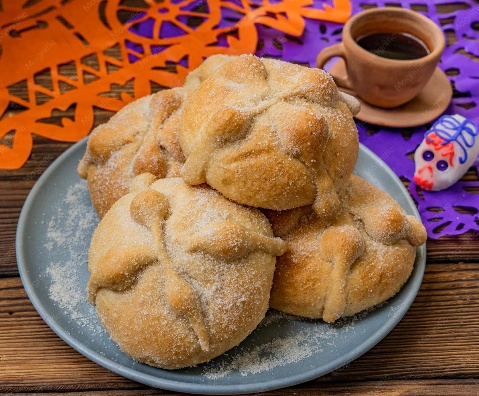
Pan de muerto is both a seasonal treat and a symbol of remembrance. Image supplied with Tara A. Spears’ article.
Mexico takes sweet rolls to another level during Día de Muertos, with signature shapes and a variety of toppings—sugar, frosting, or even a filling of whipped cream. These iconic treats are an integral part of a celebration steeped in symbolism.
UNESCO recognised the Indigenous festivity dedicated to the dead in 2003 and inscribed it on its Representative List of the Intangible Cultural Heritage of Humanity in 2008. That recognition honours the celebration and its living traditions, rather than pan de muerto alone.
A welcome for those we remember
During Day of the Dead celebrations, families prepare offerings to welcome the souls of loved ones. Flower petals, candles and favourite foods help mark the connection between the cemetery, the home and the family’s ofrenda. Flowers, paper cut-outs and familiar dishes turn remembrance into something that can be seen, smelled and shared.
Traditions vary among communities. UNESCO describes practices in which different days honour different groups of the deceased, and explains how the celebrations strengthen the bonds within Indigenous communities. Locally, each town has its own public activities worth seeing. The neighbouring town of Las Varas is known for a festival that can be an extravaganza.
More than a sweet roll
Pan de muerto, or “bread of the dead,” holds a special place in Día de Muertos celebrations. Baked to honour loved ones who have passed, this soft, slightly sweet bread is decorated with shapes associated with life, death and remembrance.
Flavours such as orange zest, orange-blossom water or anise make it distinctive. Whether placed on an ofrenda or shared around the table, the bread brings families together to remember those no longer with us.
A local taste in La Peñita
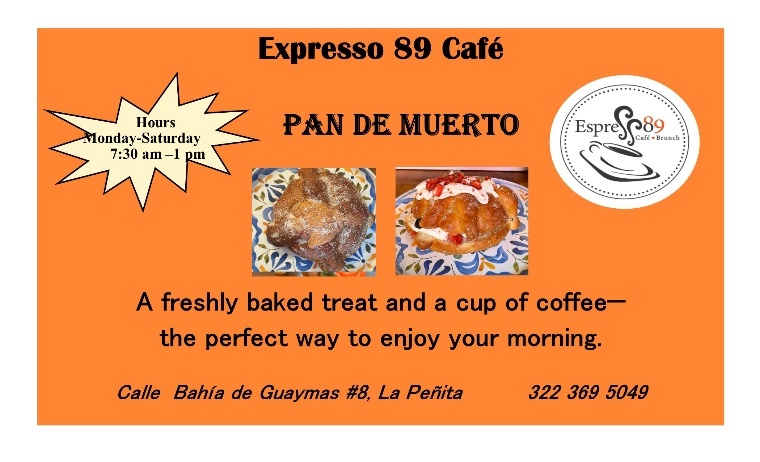
You can find fresh pan de muerto at Expresso 89 Café in downtown La Peñita. These sweet rolls are delicious with coffee and make wonderful gifts for workers or friends. The café notice supplied with this story lists Calle Bahía de Guaymas #8; check with the café for current availability and hours.
A cream-and-fruit variation on the seasonal bread. Image supplied with Tara A. Spears’ article.Expresso 89 Café notice supplied with the article. Confirm current hours and availability with the café.
The symbolism baked into the bread
For many people, the most important ingredient is not the orange-blossom water or the yeast. It is the symbolism in every curve and dusting of sugar. At first glance, the classic loaf looks like a round roll with pieces of dough arranged on top. Look again, and it becomes a small expression of remembrance.
The circle
The round shape is commonly understood to represent the cycle of life and death—a continuous loop with no beginning and no end. It offers a comforting reminder that death is part of life’s journey.
The bones and the tears
The raised strips of dough are often called huesos, or bones. They can represent the bones of the deceased, while another interpretation sees them as the tears of those left behind. The small ball at the centre is commonly associated with a skull.
The four directions
The cross-shaped arrangement is also sometimes interpreted as pointing to the four cardinal directions. These meanings are not identical everywhere: the shapes and stories vary by region and community.
Regional breads take many forms, including human figures. Image supplied with Tara A. Spears’ article.
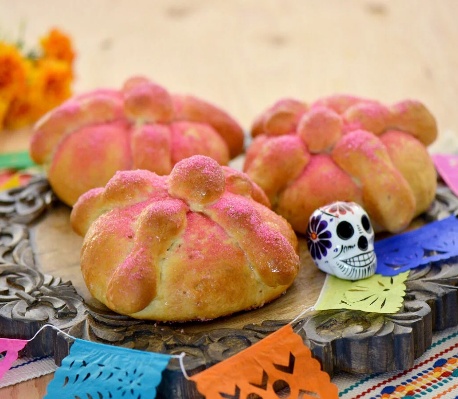
Beyond the familiar round loaf, regional variations include people, animals and skulls. Different colours, decorations and flavours bring local character to the tradition.
Pink sugar adds another variation to the classic form. Image supplied with Tara A. Spears’ article.
Enjoy pan de muerto for its taste and respect it for its symbolism. Like other parts of Day of the Dead, this sweet bread brings together pleasure, life and remembrance.
Images supplied with Tara A. Spears’ manuscript; individual photographer credits were not included.
Pacific storms lead this week’s news, alongside Tara A. Spears’ look at the Xolo dog, the traditions behind La Catrina and cultural events around Mexico.
October 11–17, 2026 · News and culture
1. Trudy keeps the Pacific coast on alert
In the October 17, 3 p.m. CST advisory, Trudy was a Category 2 hurricane. Coastal residents and travellers should check current warnings before setting out. The danger includes heavy rain, flooding and rough seas beyond the hurricane’s centre. Read the latest National Hurricane Center advisory.
2. Simón dissipates; recovery continues
NOAA’s final October 16 advisory reported that Simón had dissipated. That does not establish that affected roads, beaches or businesses have reopened. Check conditions locally before travelling. NOAA storm information.
3. Tara’s story: a companion in life and beyond
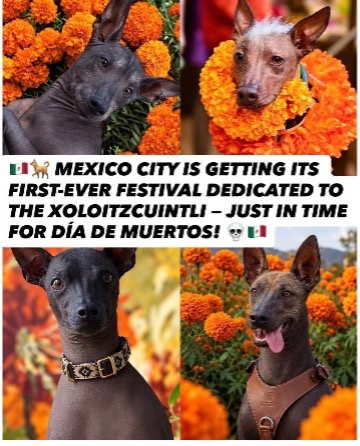
In “Xolo: Man’s Best Friend Even in the Afterlife,” Tara A. Spears explores the dog’s place in Mexican traditions and the ways communities remember beloved pets. Her story also includes local Day of the Dead programmes. Read Tara’s illustrated story.
4. La Catrina, through Bill Bell’s camera
Bill’s photo essay looks at the elegant skeleton seen across Mexico as Day of the Dead approaches. Sixteen photographs accompany the history behind this familiar figure. See the photographs and story.
5. Cervantino reaches its final weekend
Guanajuato’s 54th Festival Internacional Cervantino runs October 3–18, with France as guest country. Check the official programme for remaining performances and tickets. Official festival programme.
6. INAH offers October cultural outings
INAH’s October cultural-travel programme includes Hidalgo, Morelos, Querétaro and Tlaxcala, with visits focused on history, archaeology and art. Confirm remaining departures and availability before making plans. Read INAH’s programme.
7. Mexico announces plans for children’s online protection
President Claudia Sheinbaum announced plans on October 14 to require digital platforms to protect minors from violent and sexual content. Implementation details remain important for families and platforms. Read the report.
What drivers should know this week
Check the latest storm bulletin and local road reports before leaving. Allow extra time, avoid flooded crossings and follow official closures. Reconsider coastal trips when authorities advise against travel.
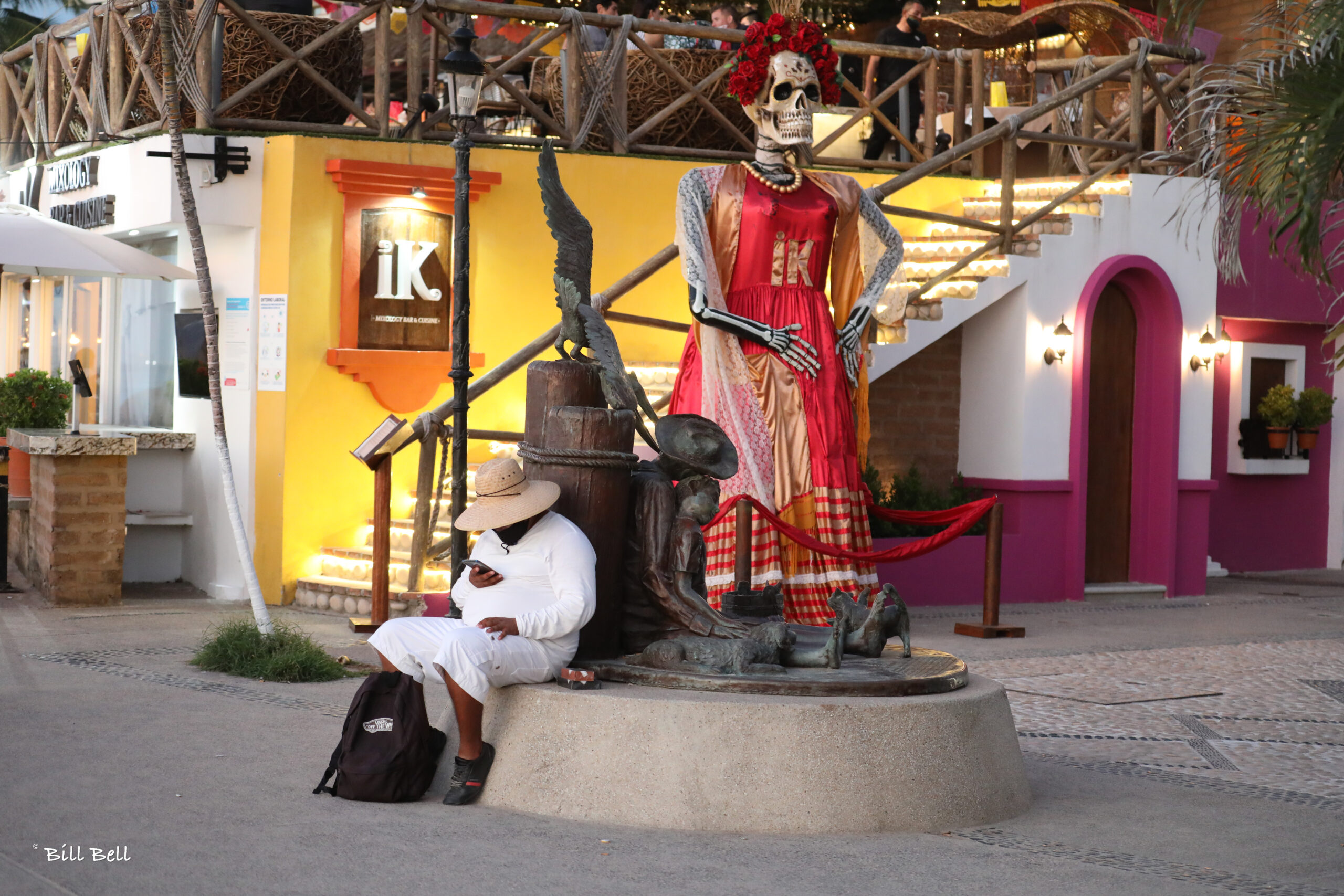
A man checks his phone beneath a towering Catrina in a red dress. Just another scene on a Mexican street. Photograph by Bill Bell.
Words and photographs by Bill Bell
One of my favourite photographs of La Catrina has very little action in it. A man sits checking his phone. Behind him, an enormous skeletal woman in a long red dress towers over the pavement. He has his business to attend to. She has hers.
That photograph says more about the place these figures occupy in Mexico than a whole parade might. Nobody needs to stop what they are doing because a skeleton is standing beside them. She belongs there.
I have kept finding her on my travels: outside shops, in public squares, painted on walls and dressed for an occasion that may or may not be happening. As Día de los Muertos approaches, the sightings multiply. Hats grow wider, dresses get more elaborate, and another familiar face turns up around the corner.
A broad, lace-trimmed hat and purple feather boa frame a painted skeletal face. La Catrina can be quite the dresser. Photograph by Bill Bell.
They’re Everywhere — Even When Nobody Is Celebrating
Look beyond the organised celebrations and there is another story. These figures share the street with parked cars, shop displays and people getting on with their day. That is often where I find the photograph I want.
A skeletal couple keeps company beside a parked car: he wears a dark hat, while she favours a pink wig and a bright red gown. Photograph by Bill Bell.
The couple beside the car looks ready for an evening out. In a shop doorway, another figure has so much colourful company that it takes a moment to pick her out. The surrounding shelves and walls are almost as busy as her outfit.
A skeletal figure in a decorated sombrero stands among a shop’s densely packed, colourful crafts. Photograph by Bill Bell.
Then there is the skeleton sharing a bench with a visitor. One arm stretches along the back, as if the seat has been saved for someone. It is an invitation to join in, and a photograph waiting to happen.
A visitor shares a bench with a grinning skeleton in a broad sombrero. There is room for the living, too. Photograph by Bill Bell.A large skull face looks out from the entrance of a red building, bringing calavera imagery into the streetscape. Photograph by Bill Bell.
The lady beneath the hat
It is easy to call every dressed-up skeleton La Catrina. Strictly speaking, they are not all the same character. La Catrina is the elegant skeletal woman associated with the work of José Guadalupe Posada and Diego Rivera. Calavera means skull, and the word also belongs to a much wider world of skeletal imagery and satire. The skull on a doorway, the painted face on a wall and the fellow on the bench belong in this story without all having to be Catrinas.
Posada’s early twentieth-century print, known as La Calavera Garbancera, shows a skull beneath an extravagant hat. Its satire is commonly read as a jab at social pretension and the desire to appear European. In 1947, Rivera gave the figure an elegantly dressed body and a central place in his mural Dream of a Sunday Afternoon in the Alameda Central, helping establish La Catrina as we recognise her today.
A mural places an elaborately hatted Catrina among historical figures, including Frida Kahlo. Photograph by Bill Bell.
Knowing that history adds something to the pleasure of finding her. The finery is part of the joke. However impressive the hat, there is still a skull underneath it.
A broad hat, rope-like hair and a purple collar give this skeletal figure a character all its own. Photograph by Bill Bell.
No shortage of imagination
What keeps me taking photographs is the variety. Just when I think I have seen every possible outfit, along comes a skeleton in purple with a red-and-white crest of hair. A little farther on, someone has gone in the opposite direction: flowers, a long veil and an enormous hat.
A red-and-white crest of hair and a purple outfit give this skeleton a distinctly punk appearance. Photograph by Bill Bell.A slender skeletal figure wears a floral dress and an oversized, veiled hat, with one hand raised beside her face. Photograph by Bill Bell.
The painted versions are just as inventive. A face recognisable as Frida Kahlo is divided between flesh and skull. Another work surrounds a woman’s painted face with roses and smaller calaveras. These artists draw from overlapping images of Mexico; they are not simply repeating one old print.
A wall painting divides Frida Kahlo’s face between a living portrait and a skull, beneath a crown of flowers. Photograph by Bill Bell.Red roses and smaller skulls surround a woman with colourful calavera-style face paint in this artwork. Photograph by Bill Bell.
Out in the squares, the figures get room to spread out. One throws both arms into the air in front of Guadalajara’s cathedral. The buildings make a useful counterpoint: solid stone behind a skeleton that seems determined to enjoy itself.
With both arms raised, a brightly dressed skeletal figure strikes an exuberant pose near Guadalajara’s cathedral. Photograph by Bill Bell.
As November approaches
The build-up to Día de los Muertos brings more of these encounters. People become part of the picture, too. Hats, flowers, face paint and a great deal of patience turn a familiar face into something quite different.
Flowers crown a woman’s carefully painted face: a living interpretation of La Catrina, in purple and gold. Photograph by Bill Bell.
In another photograph, two children stand beside a tall, dressed-up skeletal figure. I like the contrast in scale, and the ease with which they share the picture. There is room here for playfulness as well as ceremony.
Two children pose beside a tall skeletal figure wearing a hat, an orange boa and a pale skirt. Photograph by Bill Bell.
But the public spectacle is only part of Día de los Muertos. At its heart is remembrance of people who have died. Many families prepare ofrendas with photographs, candles, marigolds, food and drink, and visit or decorate graves. November 1 and 2 are central dates, though the timing and customs vary from community to community. La Catrina’s modern fame sits alongside traditions with much older roots.
A smiling skeleton does not tell us that grief is easy, or that everyone in Mexico thinks about death in the same way. What these photographs show is how much space artists and ordinary streets make for its image: sometimes solemn, sometimes elegant, sometimes very funny.
A flower-trimmed skeletal figure shares the frame with the twin towers of Guadalajara’s cathedral. Photograph by Bill Bell.
That is why I keep stopping. There is always another expression, another unlikely outfit, another small scene taking place around her. As November approaches, La Catrina becomes harder to miss. But she does not need a parade to get my attention. Sometimes all it takes is a man checking his phone and a very tall woman standing behind him.
By Bill Bell | October 13, 2026 Storm information based on NOAA’s 09:00 UTC advisory, October 13
Puerto Vallarta and Riviera Nayarit begin Tuesday with an offshore hurricane still demanding attention, while the airport operator has brought forward its reopening schedule.
Hurricane Simon remained a Category 1 hurricane in NOAA’s early Tuesday advisory, with maximum sustained winds of approximately 145 km/h (90 mph). Its centre was near 20.6°N, 107.2°W, moving slowly northwest.
NOAA continued a hurricane warning for Islas Marías and a hurricane watch for part of western Mexico’s coast. The forecast kept Simon offshore in the near term, with a possible approach to the mainland later this week. Heavy rain, flooding, mudslides, dangerous surf and rip currents remained concerns. Source: NOAA/National Hurricane Center, Discussion 24.
What this means for Puerto Vallarta and Riviera Nayarit
The offshore position is encouraging for communities concerned about the hurricane’s strongest winds. Our assessment is that the immediate focus should remain on coastal water conditions, local flooding and safe access, rather than treating the storm’s distance from shore as an all-clear.
Conditions can differ considerably between communities. An airport reopening does not establish that every beach, road or neighbourhood is safe.
Puerto Vallarta airport: reopening brought forward
Grupo Aeroportuario del Pacífico announced a two-stage reopening, replacing its earlier plan to keep the airport closed until 8 a.m. Tuesday.
Official aircraft operations resumed at 2:30 p.m. Monday, with opening to all flights, including commercial services, scheduled for 12:01 a.m. Tuesday. Individual airline schedules remain subject to confirmation. Passengers should check directly with their airline before travelling to the terminal. GAP’s reopening announcement; La Jornada’s report detailing the timetable.
San Blas: coastal flooding reported
N+ reported Monday that storm-driven seawater flooded at least three neighbourhoods in San Blas. That report underlines why communities farther north along Nayarit’s coast must continue following local instructions even as attention shifts away from Puerto Vallarta. Source: N+, October 12 report.
Roads and local services
We have not verified a comprehensive reopening notice for the coastal road network. Travellers should confirm their particular route before departure and should never drive through floodwater or around a closure.
Likewise, earlier school, beach and business restrictions should not be assumed lifted without a new local announcement.
For residents and visitors, the practical message remains: confirm flights, check local access, respect coastal restrictions and continue monitoring official updates. Simon remains an active hurricane.
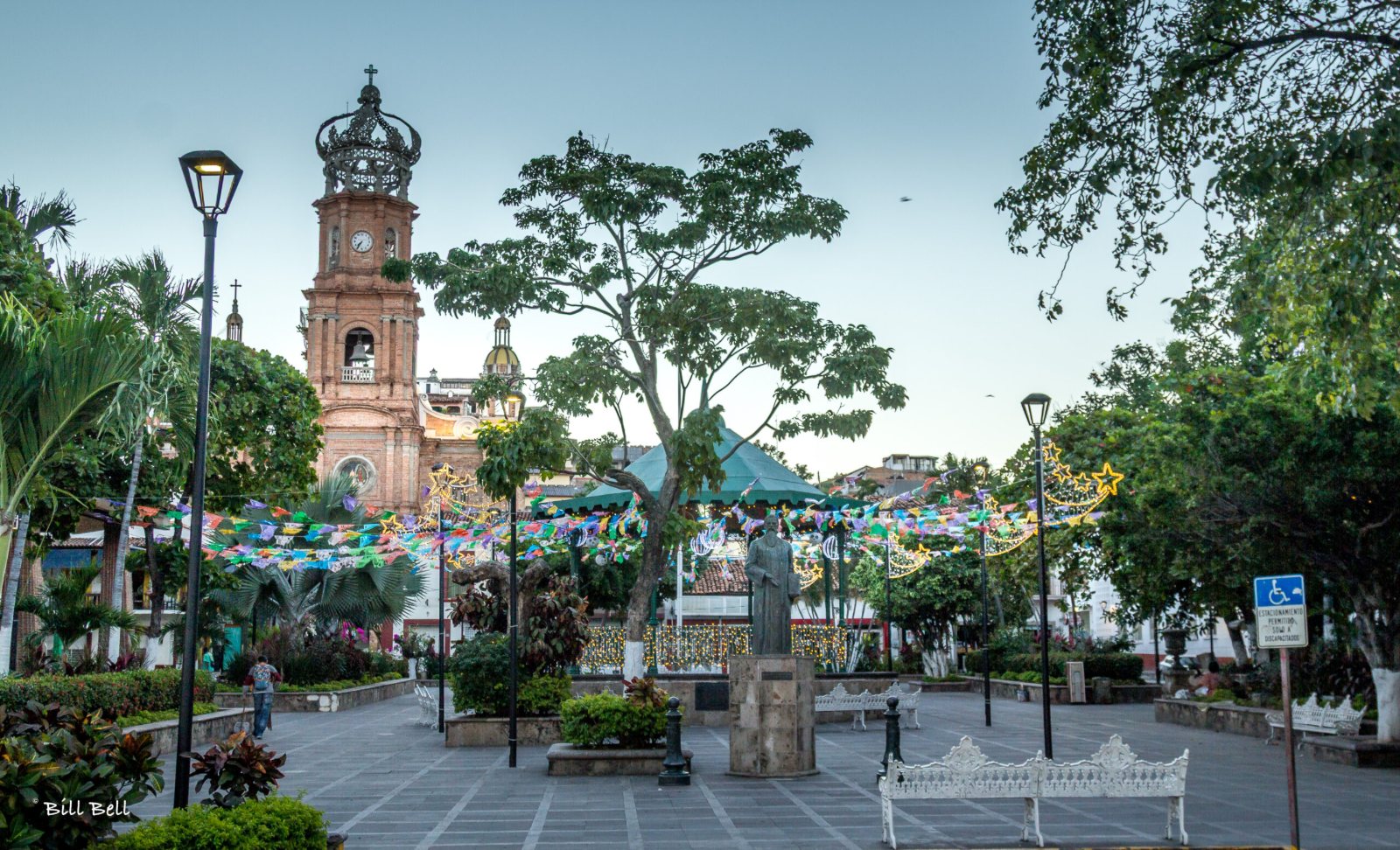
Whether it’s a cup of coffee, a cold beer, or simply people-watching from one of the many benches, Dorothy and I always seek out the town square—the plaza or zócalo.
It’s where we like to get acquainted with a town. Find some shade, settle in and watch. Someone is selling something. Someone is playing music. Friends stop to talk, children find room to play, and there is usually someone on the next bench who seems quite content to spend the afternoon.
After hours on the road, a plaza gives us a reason to stop without needing anything in particular to do. We may have arrived with a list of things to see. Quite often, the square is where we stay longer than planned.
There is something very sensible about putting benches where people actually want to sit. Under a tree. Facing the gazebo. Close enough to watch what’s happening, with no obligation to take part.
You don’t have to buy a ticket. You don’t even have to buy that coffee.
Some plazas announce themselves with elaborate ironwork, carefully tended gardens and impressive buildings. Others are modest: a gazebo, a few trees, worn paving and benches that have accommodated generations of conversations.
Both are worth stopping for.
For a visitor, the temptation is to photograph the gazebo and move along. But stay a little longer and the people begin to draw your attention. A greeting across the path. Someone arriving with shopping bags. A conversation that looks as though it began years ago and resumes whenever the participants happen to meet.
The buildings provide the setting. The people give you a reason to linger.
In La Peñita, even the gazebo gives the camera plenty to consider. There are patterns, colours and a whale worked into its curved surface. Around it, the square carries on with its ordinary business.
That’s part of what I enjoy photographing. The architecture matters, but so does the person pushing a cart past it. A photograph can hold both—the place people come to see and the life taking place around it.
A few musicians can change the feeling of a square. People turn their heads. Someone pauses on the way somewhere else. Others keep talking, with the music becoming part of the afternoon.
I like the layers in a scene like this. The performers in front, the people sitting behind them, and more activity disappearing into the shade. There is plenty going on without anyone arranging it for the photograph.
The challenge is deciding where to point the camera—and remembering to put it down occasionally.
Not every square is busy when we arrive. Sometimes the pleasure is the quiet: leaves overhead, a few people passing and a chance to sit beside Dorothy without consulting a map or deciding how much farther to drive.
Travel can become a succession of arrivals and departures if you let it. The plaza interrupts that habit.
And if you can stay until evening, there is another photograph waiting.
The heat eases. Lamps come on. Buildings that seemed familiar an hour earlier look different against the evening sky. There is a temptation to take one more photograph, then another.
Eventually we get up and carry on. There will be another road, another town and something else we intended to see.
But wherever we arrive, we’ll look for the square.
A coffee, perhaps. A cold beer if the moment suits. Or just an empty bench beside Dorothy, watching Mexico go about its day.
Most people driving Highway 15 south to the beach towns never set foot in Hermosillo. The new ring road makes it easy to bypass the capital of Sonora altogether, and for years that’s exactly what a lot of travellers do.
That’s a mistake. Hermosillo is Sonora’s largest city, with close to a million people and a real industrial base built in part on auto manufacturing. It also earns its nickname honestly — locals call it the City of Sun, and from May through November the highs routinely clear 45°C.
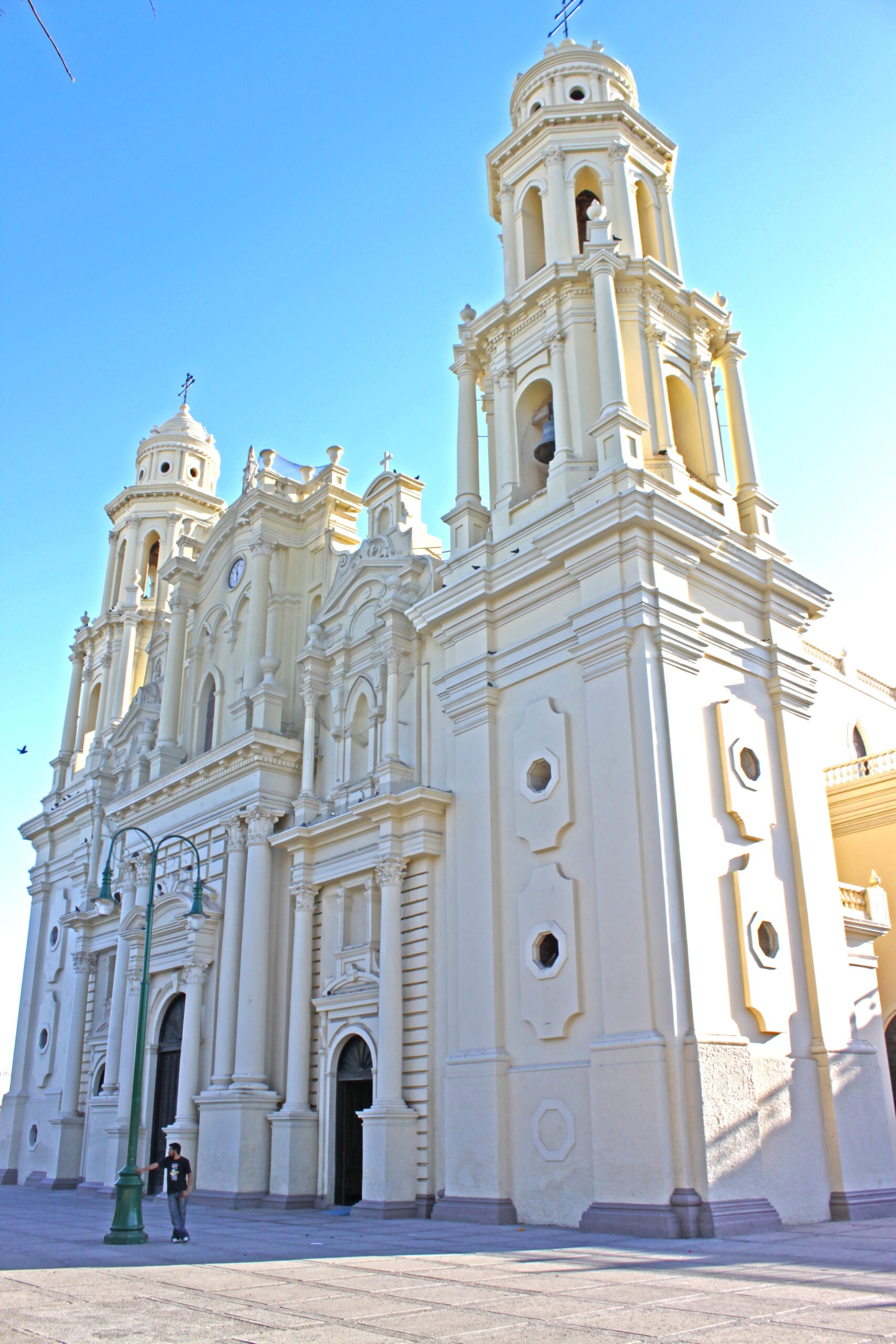
None of that matters once you’re standing in the historic center. The main square is lined with handsome colonial buildings, the Cathedral of the Assumption of the Blessed Virgin Mary dominates the skyline, and the restaurants serve some of the best Sonoran cooking you’ll find anywhere in the state.
From Nogales it’s a straightforward drive — about 3½ hours, 178 miles or 286 km — so it’s an easy add to any trip down the coast.
Have you driven through Hermosillo, or always bypassed it on the cuota? Let us know in the comments.