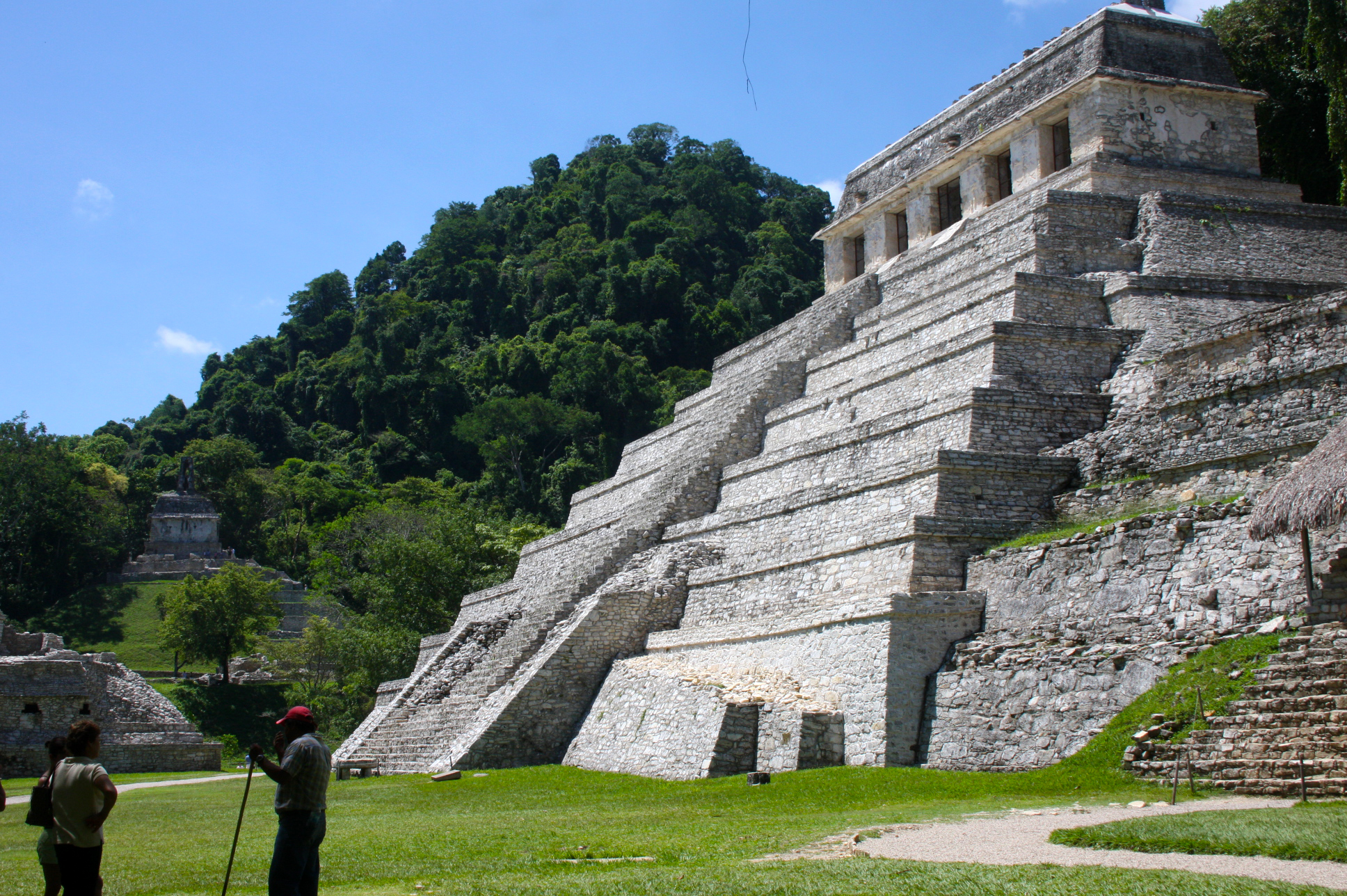
Most Maya sites make you imagine the jungle that used to surround them. At Palenque, you don’t have to imagine it – it’s still there, closing in right at the edge of the plazas, with the calls of howler monkeys carrying over the ruins most mornings.
A King Crowned at Twelve
Palenque’s story is really the story of one man: K’inich Janaab’ Pakal, who took the throne at age twelve after the city had been badly beaten down by its rival Calakmul, and then ruled for 68 years. Nearly everything visitors see today – the Palace, the temples, the astronomical alignments built into the architecture – dates from his reign or his son’s. He didn’t just rebuild a defeated city. He turned it into one that, by the accounts left behind, eclipsed even Tikal.
What Was Found Inside the Temple of Inscriptions
Pakal’s funerary temple is the site’s centerpiece, and for a good reason: in 1952, archaeologist Alberto Ruz Lhuillier climbed down a hidden staircase sealed for over a thousand years and found Pakal’s tomb waiting exactly as it had been left – jade mask, jade jewelry, and a carved sarcophagus lid whose imagery has been endlessly (and wrongly, per mainstream archaeology) reinterpreted online as depicting an astronaut. It isn’t. It’s a king falling into the underworld to be reborn, straight out of Maya cosmology. It’s still one of the richest royal burials ever found anywhere in the Americas.
Why It Went Quiet
By around 799 AD, Palenque was abandoned, part of the broader collapse that hit Maya cities across the region. The jungle did the rest, swallowing the site so completely that Spanish explorers who stumbled onto it in the 1520s barely registered what they’d found. Serious excavation didn’t start until 1773, and the tomb itself sat undiscovered for another 180 years after that.
The Video
Photography by Bill Bell. Produced by Dorothy Bell.
Planning to drive there yourself? We’ve laid out the logistics – the drive in, hours and admission, and the Highway 199 safety note – over on our sister site: Visiting Palenque: The Logistics.
Between the setting and the history, Palenque tends to hit people differently than the more open sites like Chichén Itzá or Uxmal. What was your reaction the first time you stood in front of it?
Leave a Reply