By Bill Bell · Photography by Bill Bell
Leer este ensayo fotográfico en español
A visit to Guadalajara is not complete without spending some time at the Cabañas. And I do mean spending time. This is a place that deserves more than a quick walk through, a photograph and a check mark on the sightseeing list.
There is something extraordinary about standing beneath José Clemente Orozco’s murals. Your eyes move from one figure to another, following a hand, a face, a sweep of colour. Then you look higher, into the dome, and find yourself caught up in something much larger than you expected.
Mexico has given Dorothy and me so many reasons to keep exploring. Its history and the ways its artists confront that history are among the most compelling. At the Cabañas, you can feel how closely the two are connected.
The building itself has a story worth knowing. The former Hospicio Cabañas was established to shelter people in need, including children and the elderly. Its courtyards and orderly architecture speak of that original purpose. Today, the complex is a UNESCO World Heritage Site, recognised for both its architecture and the remarkable paintings within it. Read UNESCO’s account of the Hospicio Cabañas.
Then you enter the chapel, and the mood changes.
Orozco painted its 57 frescoes between 1937 and 1939. Born in Jalisco, he became one of the great figures of Mexican muralism. Here, he used the walls and vaults to explore conquest, religion, machinery, oppression and the contradictions of humanity. It is an enormous undertaking, in both scale and ambition. Museum history · Orozco’s murals.
You do not need to arrive with a degree in art history to feel their force.

Look at the faces. Some seem burdened, others hardened. Groups of figures press together. A hand grips a cross. A ship pitches into a sweeping sea. The bodies and gestures carry a tension that reaches you before you have worked out the symbolism.

To my eye, there is very little reassurance in these scenes. They ask difficult questions about power, belief and what people do to one another. You may admire the painting and feel uncomfortable at the same time. That is part of what makes the visit so memorable.

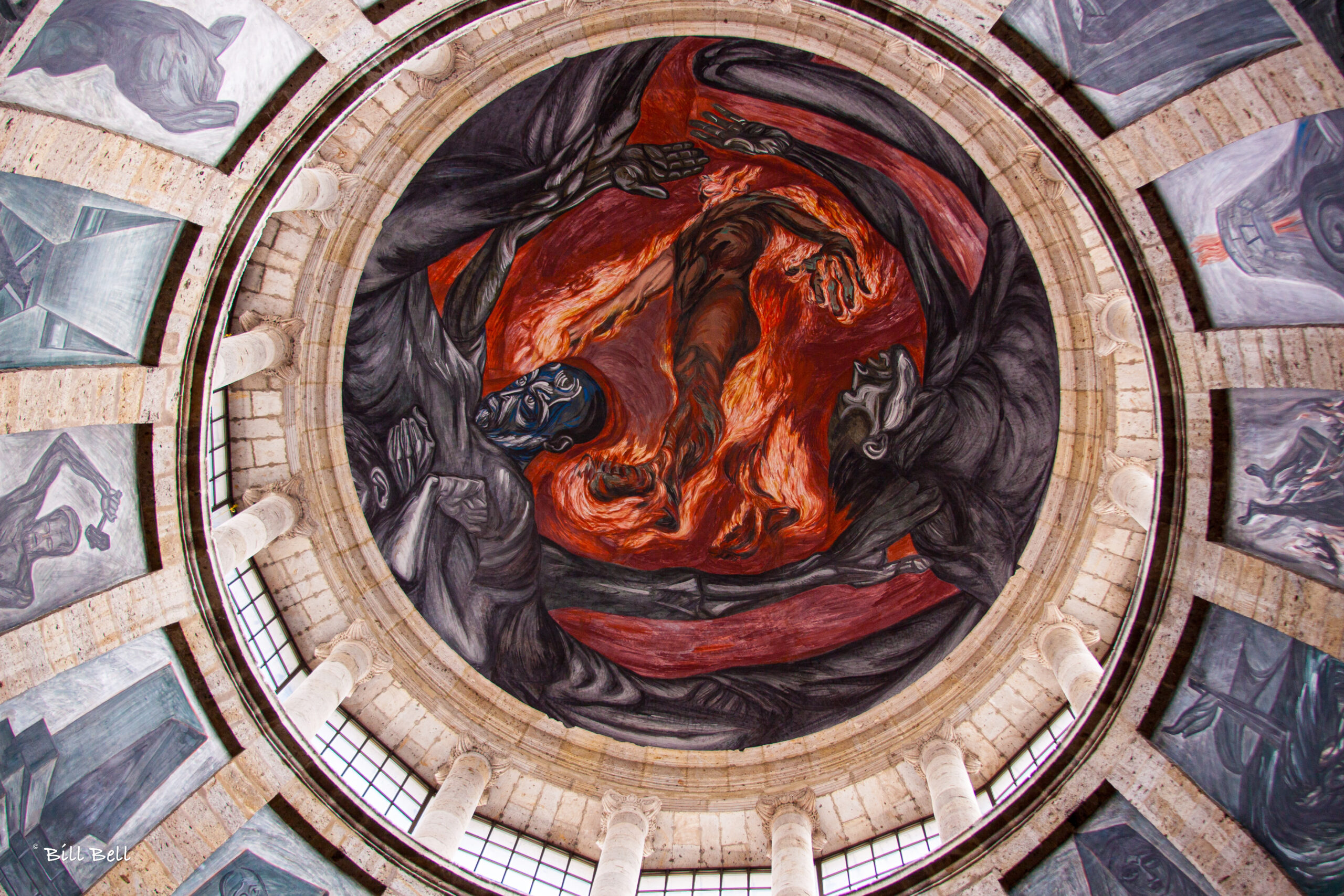
And above it all is El Hombre de Fuego—The Man of Fire.
The figure stretches through a blaze of orange and red, surrounded by darker bodies that follow the curve of the dome. It is difficult to find a resting place for your eyes. Everything seems to turn, reach or pull you farther into the painting.
Whether you see suffering, transformation or some struggle between the two, the image stays with you. I would hesitate to reduce it to a tidy explanation. Part of its power is that you can keep looking and still have questions.
For a photographer, the challenge is deciding how much to include.
A wide photograph shows how the painting belongs to the building: the circle of stone, the windows, the figures gathered around the dome. Move closer with the lens and the experience changes. A face or a hand becomes the centre of attention. The great sweep of the mural gives way to a small, deeply human detail.

These photographs move between those views. They show the scale, but also the expressions and gestures that make you want to look again.
Still, a photograph can only take you so far. It cannot quite give you the sensation of standing below all that painted space, turning slowly and discovering that there is something demanding your attention in every direction.
That is why I would give the Cabañas an unhurried part of a day. Spend time beneath the dome. Look at the surrounding paintings. Step into a courtyard and let your eyes rest, then return for another look.

There is plenty in Guadalajara to keep a visitor happily occupied. But the Cabañas offers something that goes beyond an enjoyable afternoon. It leaves you thinking about Mexico, about its history, and about the extraordinary ability of an artist to make that history feel urgent and personal.
Go for the murals. Give yourself time to feel them. You may find they accompany you long after you have left Guadalajara.
More through Bill’s camera: Mexico in Motion: Our Love of Folklórico and We Always Stayed Longer at the Ruins.
Planning your journey to Guadalajara? Visit our Mexico trip-planning guides and Mexico vehicle insurance information before you set out.