Every October 12, Guadalajara walks. The Virgin of Zapopan leaves the city’s cathedral and is carried about nine kilometres to her basilica in Zapopan. This is the Romería, one of the largest pilgrimages in Mexico. In 2022 the governor of Jalisco reported 2.4 million people along the route.
The figure is small, about 34 centimetres, made of corn-stalk paste by indigenous artisans in the 16th century. She has been in the Zapopan area for some 400 years, and the procession is usually dated to 1734.
She is called La Generala. On September 15, 1821, she was named General of the Trigarante Army, days before Mexico’s independence. In 1921 Pope Benedict XV authorized her papal coronation. In 2018 UNESCO listed the Romería as Intangible Cultural Heritage.
Advertisement
We started in the square in front of Guadalajara’s cathedral. The crowds got bigger as we came in. Dance groups were already there, in feathers, masks, ribbons and bells, waiting for the procession to begin. Many carried banners with the name of their parish.
Dancers gather in the plaza before the procession starts, with the cathedral towers beyond.
When it set off, we walked with it, along with thousands of others. We managed part of the way. Then we got tired and cheated, and hopped on a bus. The walkers kept going.
Dancers in red shirts and white-and-red feather hats.Two men in plaid-ribbon hats, one pulling on a bearded mask.A dancer in a feather headdress topped with a skull.
Advertisement
Profile of a young dancer under a stitched headdress and long feathers.A masked walker in a coat, with a medal around his neck.A couple in matching costumes, holding hands and carrying water.A group carries a banner for the Virgin of Zapopan.
A visit to Guadalajara is not complete without spending some time at the Cabañas. And I do mean spending time. This is a place that deserves more than a quick walk through, a photograph and a check mark on the sightseeing list.
There is something extraordinary about standing beneath José Clemente Orozco’s murals. Your eyes move from one figure to another, following a hand, a face, a sweep of colour. Then you look higher, into the dome, and find yourself caught up in something much larger than you expected.
Mexico has given Dorothy and me so many reasons to keep exploring. Its history and the ways its artists confront that history are among the most compelling. At the Cabañas, you can feel how closely the two are connected.
The building itself has a story worth knowing. The former Hospicio Cabañas was established to shelter people in need, including children and the elderly. Its courtyards and orderly architecture speak of that original purpose. Today, the complex is a UNESCO World Heritage Site, recognised for both its architecture and the remarkable paintings within it. Read UNESCO’s account of the Hospicio Cabañas.
Then you enter the chapel, and the mood changes.
Orozco painted its 57 frescoes between 1937 and 1939. Born in Jalisco, he became one of the great figures of Mexican muralism. Here, he used the walls and vaults to explore conquest, religion, machinery, oppression and the contradictions of humanity. It is an enormous undertaking, in both scale and ambition. Museum history · Orozco’s murals.
You do not need to arrive with a degree in art history to feel their force.
Faces and gestures carry the emotional weight of Orozco’s paintings. Photography by Bill Bell.
Look at the faces. Some seem burdened, others hardened. Groups of figures press together. A hand grips a cross. A ship pitches into a sweeping sea. The bodies and gestures carry a tension that reaches you before you have worked out the symbolism.
A ship and a sweeping sea: movement painted into the curve of the architecture. Photography by Bill Bell.
To my eye, there is very little reassurance in these scenes. They ask difficult questions about power, belief and what people do to one another. You may admire the painting and feel uncomfortable at the same time. That is part of what makes the visit so memorable.
Symbols of belief and power invite a closer look. Photography by Bill Bell.
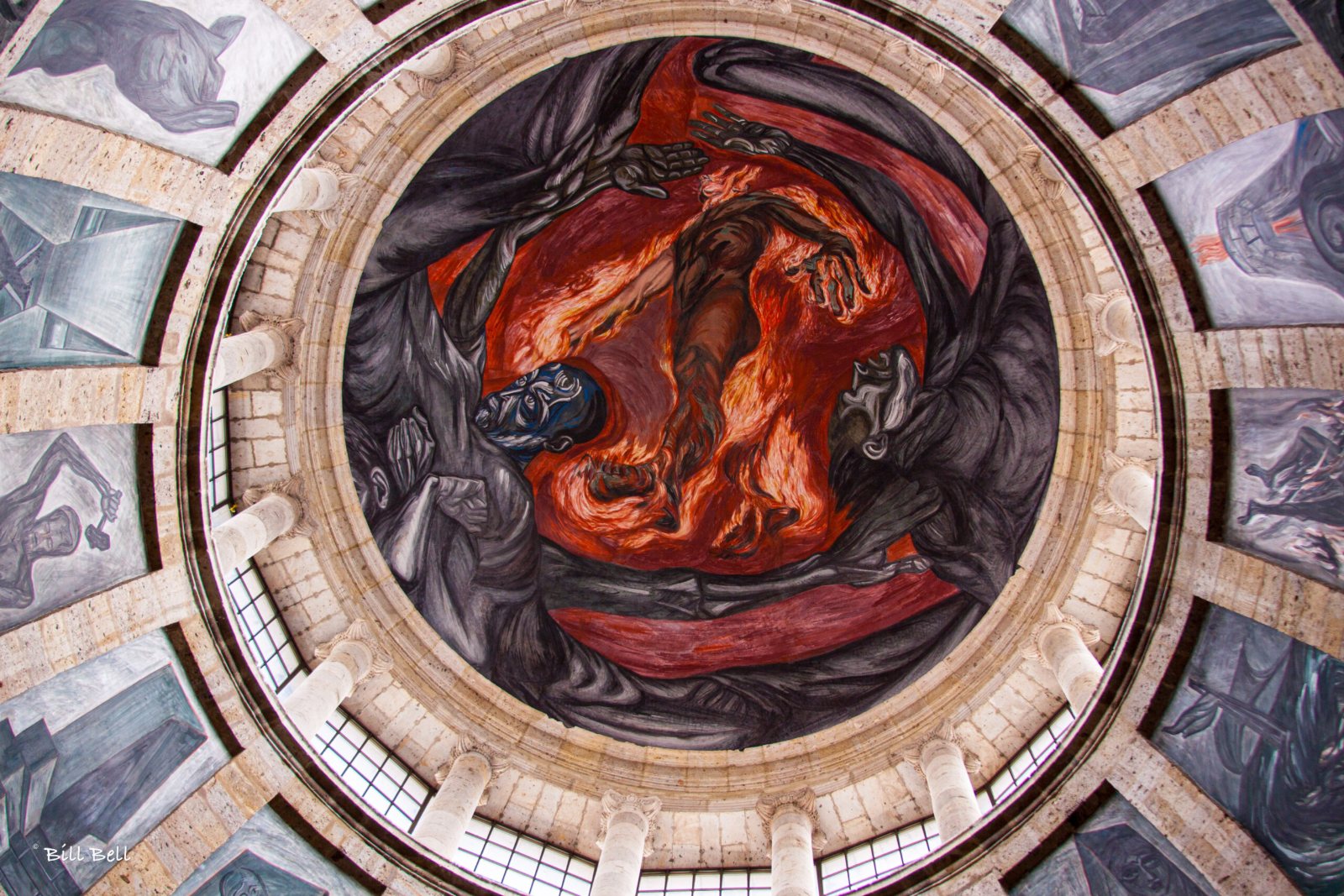
And above it all is El Hombre de Fuego—The Man of Fire.
The figure stretches through a blaze of orange and red, surrounded by darker bodies that follow the curve of the dome. It is difficult to find a resting place for your eyes. Everything seems to turn, reach or pull you farther into the painting.
Whether you see suffering, transformation or some struggle between the two, the image stays with you. I would hesitate to reduce it to a tidy explanation. Part of its power is that you can keep looking and still have questions.
For a photographer, the challenge is deciding how much to include.
A wide photograph shows how the painting belongs to the building: the circle of stone, the windows, the figures gathered around the dome. Move closer with the lens and the experience changes. A face or a hand becomes the centre of attention. The great sweep of the mural gives way to a small, deeply human detail.
A quieter detail beneath the dome rewards patient looking. Photography by Bill Bell.
These photographs move between those views. They show the scale, but also the expressions and gestures that make you want to look again.
Still, a photograph can only take you so far. It cannot quite give you the sensation of standing below all that painted space, turning slowly and discovering that there is something demanding your attention in every direction.
That is why I would give the Cabañas an unhurried part of a day. Spend time beneath the dome. Look at the surrounding paintings. Step into a courtyard and let your eyes rest, then return for another look.
Returning to the fire: a closer view of the dome’s restless colour and movement. Photography by Bill Bell.
There is plenty in Guadalajara to keep a visitor happily occupied. But the Cabañas offers something that goes beyond an enjoyable afternoon. It leaves you thinking about Mexico, about its history, and about the extraordinary ability of an artist to make that history feel urgent and personal.
Go for the murals. Give yourself time to feel them. You may find they accompany you long after you have left Guadalajara.