Words and photographs by Bill Bell, with a closing reflection from Dorothy Bell
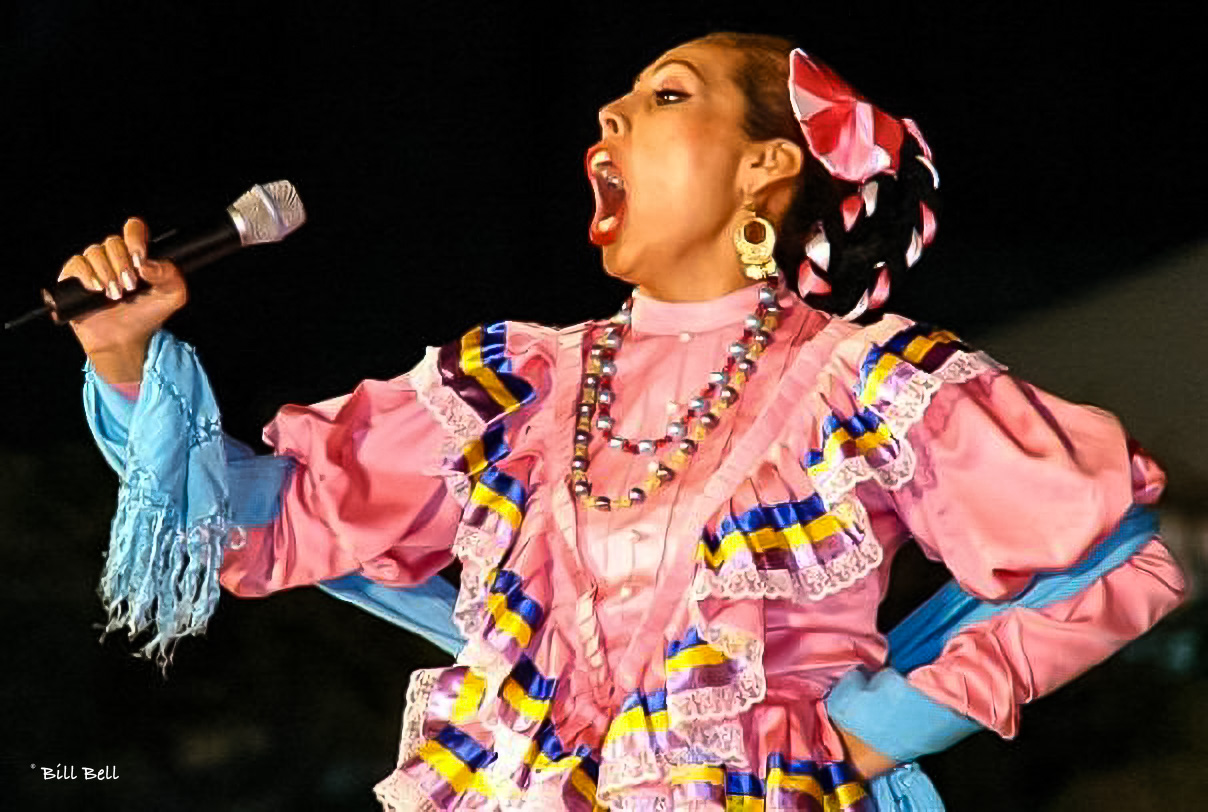
Everywhere we go in Mexico, folklórico seems to find us. Guadalajara, Mexico City, beachside communities—somewhere the music starts, the skirts begin to move, and there I am with the camera again.
Dorothy and I have watched countless performances over the years. You might think we would eventually have enough photographs of swirling dresses. Apparently not.
Folklórico loves the camera. A skirt opens into a great fan of colour, ribbons trace the movement, and a dancer’s expression changes just as you press the shutter. The challenge is deciding where to look. Follow the dress and you might miss the smile. Watch the feet and you miss the exchange between partners.
And those exchanges are part of the pleasure. There is humour, pride and flirtation—a glance, an approach, a turn away. Even without knowing the story behind a particular dance, you find yourself drawn into the conversation.

The dresses are another reason to keep watching. Their styles, colours and details help express the different regional traditions represented in the performances. I would not pretend to identify every costume correctly, but I appreciate how much variety there is within what we casually call Mexican dance.

Some of our enjoyment has come from watching polished stage performances. Just as memorable are the dancers we encounter in smaller communities, where the performance feels close enough to be part of the gathering.
For Dorothy and me, these are among the experiences that have kept Mexico interesting through all our years of travelling here. There is always another performance worth stopping for, another expression worth trying to catch.

Then folklórico became part of our own family.
Our granddaughter Shanti lives in both Canada and Mexico, and while in Mexico she has been learning folklórico dance. Her grandmother Dorothy spent many long hours sewing her a dress.
I photograph the finished result. Dorothy knows rather more about the work that goes into making all that fabric move.
I love this photograph of the two of them. After all the movement in the other pictures, here is a quiet moment: a grandmother, a granddaughter and a dress made with care.
For Shanti, learning the dance is one way of taking part in the Mexican side of her life. For us, it has made something we have enjoyed watching for years a little more personal.
Dorothy has her own memories of that dress, and hers are the right words to finish with:

“Of all the projects I have sewn, the folkloric skirt was my favourite. Ever.
“Every seam, every ribbon was attached with care and love. I thought about Shanti and her future. Thought about all the rehearsals and performances. I thought about her and the love we have for this extraordinary artist. It was a gift of love. Total love.
“And I was somewhat sad to have it finished and wrapped up to present to her. I was enjoying the process of making something so beautiful for someone very special to us.”
— Dorothy Bell
More of Mexico through Bill’s camera: Ballet Folklórico in Guadalajara and We Always Stayed Longer at the Ruins.
Planning your own journey? Start with On the Road in Mexico and our Mexico trip-planning pages.